News Update :

ontribute to the wealth of information, and to promote understanding among the people, and anyone who likes to learn more about Islam...

Showing posts with label Women. Show all posts

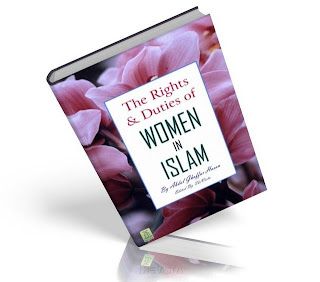
The Rights and Duties of Women in Islam Introduction

The subject of the rights and duties of women in Islam has often been clouded by controversy, personal opinions and sheer ignorance. Although many scholars have dealt with this subject, there has remained a need to discuss wider aspects of the issue than are often tackled. Maulana Abdul Ghaffar Hasan, a scholar of Hadith and member of the Islamic Ideological Council in Pakistan, originally presented this topic to the Council as a short Urdu paper for discussion. Considering it to be a concise yet useful contribution to the field, I rendered it into English. I am very grateful to my daughter Khola Hasan who not only edited the English version but also contributed to it with her thoughts, thus adding to its substance beautifully. 
The Rights and Duties of Women in Islam Introduction book


I hope that this booklet will help to remove some of the misunderstandings, prejudiced opinions and falsehoods, which circulate about the rights, and duties of women in Islam. 


The issue of Women in Islam has been the subject of all kinds of controversies, misunderstandings and especially misinformation. This work will discuss and explain this subject according to the precise teachings of the Qur�aan and the Sunnah (sayings, acts, i.e., the traditions) of Allah�s Messenger. 


To begin with, the most important aspect of the entire issue is the spiritual aspect. The Muslim accepts that the main purpose behind the creation of jinn and mankind was that they should worship Allah, struggle against the forces of Satan and live their life according to Allah's Commandments in order to achieve eternal bliss in Paradise.


Abdul Ghaffar Hasan | Language: English | Format: PDF | Pages: 29 | Size: 5 MB


 Download,   preview


Dr. Suhaib Hasan
التعليقات | | Read More...

Sisterhood in Islam (A Letter from One Muslim SIster to Another)


As Muslims sisters strive to gain knowledge about their religion and endeavor to increase their Iman, there is one issue of importance that often seems to be neglected. This is the issue of Sisterhood in Islam.

Sisters may greet each other, spend time socializing, give gifts during happy occasions, cook for those who have a new baby, etc., but this is only the surface level of Sisterhood. To understand what this special relationship really means we must go much deeper than that.

We need to go to the level of the heart from which the bonds of Sisterhood emanate. This relationship is very special because it involves a unique type of love; one that cannot be experienced in any other social connection. It is a feeling that is particularly extraordinary for those of us who are revert/converts to Islam.

To really enjoy the beauty of this bond we need to completely comprehend the elements that are involved. A letter has been written to each of us to assist us in this endeavor, Insha-Allah. Let us put this knowledge in our hearts and we will begin to see the seeds of true Sisterhood grow into a beautiful, flowering plant, Insha-Allah.

Assalamu Alaikum Wa Rahmatullah Wa Baraktuh

My Dear Sister in Islam:
As Muslims sisters strive to gain knowledge about their religion and endeavor to increase their Iman, there is one issue of importance that often seems to be neglected. This is the issue of Sisterhood in Islam.  Sisters may greet each other, spend time socializing, give gifts during happy occasions, cook for those who have a new baby, etc., but this is only the surface level of Sisterhood. To understand what this special relationship really means we must go much deeper than that.  We need to go to the level of the heart from which the bonds of Sisterhood emanate. This relationship is very special because it involves a unique type of love; one that cannot be experienced in any other social connection. It is a feeling that is particularly extraordinary for those of us who are revert/converts to Islam.  To really enjoy the beauty of this bond we need to completely comprehend the elements that are involved. A letter has been written to each of us to assist us in this endeavor, Insha-Allah. Let us put this knowledge in our hearts and we will begin to see the seeds of true Sisterhood grow into a beautiful, flowering plant, Insha-Allah.

Insha-Allah, everything is well with you and those close to you. I am writing this letter to let you know how much I care and to help us both gain an understanding of what Sisterhood in Islam really means, Insha-Allah. I care about you because we share something that is more special than the whold world and all that it contains; we share the belief in the Onenesss of Allah (SWT) and the religion that He (SWT) has given to us. This is a gift that transcends any differences we may have in regard to race, color, nationality, culture or language. Being a sister in Islam is one of the many blessings that comes from acceptance of the true path of Allah (SWT). It is also a responsibility that we each have as members of the Muslim Ummah. To fufill our obligation, we first need to understand what is required of us.

This is what the bond of Sisterhood in Islam means to me, based upon the wisdom of Allah and his Prophet Muhammad (SAW),
"...And lower your wing for the believers (be courteous to the fellow-believers)." (Al-Hijr 15:88)

The Prophet (SAW) said,

"None of you has Iman (faith) until he desires for his brother (or sister) Muslim that which he desires for himself (or herself)." (Bukhari and Muslim)

He (SAW) also said,

"The Muslims in their mutual love, kindness and compassion are like the human body where when one of its parts is in agony the entire body feels the pain, both in sleeplessness and fever." (Bukhari and Muslim)

I love you for the sake of Allah (SWT) ...
The Messenger of Allah (SAW) said,

"On the Day of Judgement, Allah, the Most High, will announce, 'Where are those who love each other for the sake of My pleasure? This day I am going to shelter them in the shade provided by Me. Today there is no shade except My shade." (Muslim)

I will be sure to tell you of my love, Insha-Allah ...

The Prophet (SAW) said,

"If a person loves his brother, he should inform him of this fact." (Abu Dawud and Tirmidi)

I will be merciful and compassionate toward you, Insha-Allah ...

Allah (SWT) says,

"Muhammad is the Messenger of Allah, and those who are with him are severe against the disbelievers, and merciful among themselves..." (Al-Fath 48:29)

The Prophet (SAW) said,

"Do not be envious of other Muslims; do not overbid at auctions against another Muslim; do not have malice against a Muslim; do not go against a Muslim and forsake him; do not make an offering during a pending transaction. O' servants of Allah, be like brothers (or sisters) with each other. A Muslim is the brother (or sister) of another Muslim; do not hurt him (or her), or look down upon him (or her) or bring shame on him (or her). Piety is a matter of heart (The Prophet (SAW) repeated this thrice). It is enough evil for a person to look down upon his Muslim brother (or sister). The blood, property and honor of a Muslim is inviolable to a Musilm." (Muslim)

I will keep company with you, Insha-Allah ...

The Prophet (SAW) said,

"Keep company with a believer only, and let your food be eaten only by the righteous." (Abu Dawud and Tirmidi)

He (SAW) also said,

"A person is likely to follow the faith of his friend, so look whom you befriend." (Abu Dawud and Tirmidi)

I will help you when necessary and I will cover your shortcomings, Insha-Allah ...

The Prophet (SAW) said,

"One who helps a fellow Muslim in removing his (or her) difficulty in this world, Allah will remove the former's distress on the Day of Judgement. He who helps to remove the hardship of another, will have his difficulties removed by Allah in this world and in the Hereafter. One who covers the shortcomings of another Muslim, will have his faults covered up in this world and the next by Allah. Allah continues to help a servant so long as he goes on helping his own brother (or sister)." (Muslim)

I will encourage you to the right, Insha-Allah ...

Allah (SWT) says,

"The believers, men and women. are Auliya (helpers, supporters, friends, protectors) of one another, they enjoin (on people) Al-Ma'ruf (i.e. Islamio Monotheism and all that Islma orders one to do), and forbids (people) from Al-Munkar (i.e. polytheism and disbelief of all kinds, and all that Islam has forbidden); they offer their prayers perfectly (Iqamat-as-Salat); and give the Zakat and obey Allah and His Messenger. Allah will have His mercy upon them. Surely, Allah is All-Mighty, All-Wise." (At-Tauba 9:71)

When the Prophet (SAW) instructed,

"Help your (Muslim) brother (or sister) when he commits a wrong and when a wrong is committed against him, someone asked, "O Messenger of Allah, I understand how I can help him if a wrong is committed against him, but how can I help him if he is himself committing a wrong?" At that the Prophet (SAW) answered, "Stopping him from committing the wrong is helping him." (Bukhari)

I will fulfill my minimum duties and beyond, Insha-Allah ...

The Prophet (SAW) said,

"A Muslim owes six obligations towards another Muslim: when you meet him (or her), salute him (or her) saying 'Assalamu Alaikum; when he (or she) invites you, accept his (or her) invitation; when he (or she) solicits your advice, advise him (or her) sincerely; when he (or she) sneezes and praises Allah, respond with the supplication Yarhamuk Allah (Allah have mercy on you); when he (or she) falls sick, visit him (or her); on his (or her) death, join his (or her funeral)." (Muslim)

He (SAW) also said,

"When a Muslim visits his (or her) Muslim brother (or sister) who is sick, he (or she) certainly gathers the fruits of Paradise until he (or she) returns (from visiting)." (Muslim)

You should understand, dear sister, that these are only some of the promises that I have made to you and to Allah (SWT), Insha-Allah. I will strive to fufill each of them to the best of my ability, Insha-Allah. Insha-Allah you will do the same for all of your sisters in Islam. This will not only enhance our bounds of Sisterhood, but will also strengthen the fibers of the Muslim Ummah as we acquire and utilize the wisdom of Islam, Insha-Allah. Our ultimate goal is to gain the pleasure of Allah (SWT), as well as His Mercy and Blessings, Insha-Allah. May we both find the true peace that comes with being a Muslim and attaing the highest of rewards: Paradise. Ameen!!!

With true love,

Your Sister in Islam

Walaikum Assalam Wa Rahmatullah Wa Baraktuh

التعليقات | | Read More...

Why Are Women Turning to Islam


At a time when Islam is faced with hostile media coverage particularly where the status of women in
Islam is concerned, it may be quite surprising to learn that Islam is the fastest growing religion in the world, and even more ironic to discover that the majority of converts to Islam are WOMEN

The status of women is society is neither a new issue nor is it a fully settled one, and where Islam is mentioned, for many the term 'Muslim Women' prompts images of exhausted mothers chained to the stove, 'victims' suppressed in a life of indoctrination, frantic to be westernised and so on. Others will go to great lengths to explain how the hijab is an obstacle, clouding the mind, and comment that female converts are either brainwashed, stupid or traitors to their sex. I reject such accusations and pose to them the following question: why is it that so many women who have been born and brought in the so called 'civilized' societies of Europe and America are willing to reject their 'liberty' and 'independence' to embrace a religion that supposedly oppresses them and is widely assumed to be prejudicial to them?

As a Christian convert to Islam, I can only present my personal experience and reasons for rejecting the 'freedom' that women claim to have in this society in favour of the only Religion that truly liberates women by giving us a status and position which is completely unique when compared with that of non-Muslim counterparts.

Before coming to Islam, I had strong feminist tendencies and recognized that where the women was concerned, a lot of shuffling around had been going on, yet without being able to pin her on the social map. The problem was ongoing: new 'women's issues' being raised without the previous ones being satisfactorily resolved. Like the many women who shared my background, I would accuse Islam of being a sexist religion, discriminating, oppressing and giving men the greater privileges. All this coming from a person who did not even know Islam, one who had been blinded due to ignorance and had accepted this deliberately distorted definition of Islam.

However, despite my criticisms of Islam, inwardly I wasn't satisfied with my own status as a women in this society. It seemed to me that society would define such terms as 'liberty' and 'freedom' and then these definitions were accepted by women without us even attempting to question or challenge them. There was clearly a great contradiction between what women were told in theory and what actually happens in practice.

The more I pondered the greater emptiness I felt within. I was slowly beginning to reach a stage where my dissatisfaction with my status as a woman in this society, was really a reflection of my greater dissatisfaction with society itself. Everything seemed to be degenerating backwards, despite the claims that the 1990's was going to be the decade of success and prosperity. Something vital seemed to be missing from my life and nothing would fill this vacuum. Being a Christian did not do anything for me, and I began to question the validity of only remembering God one day a week - Sundays! As with many other Christians too, I had become disillusioned with the hypocrisy of the Church and was becoming increasingly unhappy with the concept of Trinity and the deification of Jesus. Eventually, I began to look into Islam. At first, I was only interested in looking at those issues which specifically dealt with women. I was surprised. What I read and learned taught me a lot about myself as a woman, and also about where the real oppression of women lies: in every other system and way of life outside of Islam. Muslim women have been given their rights in every aspect of the religion with clear definitions of their role in society - as had men - with no injustice against either of them. As Allah says:

Whoever does deeds of righteousness, be they male or female, and have faith, they will enter paradise and not the least injustice will be done to them

[Qur'an Nisa 4:124]

So having amended my misconceptions about the true status of women in Islam, I was now looking further. I wanted to find that thing which was going to fill the vacuum in my life. My attention was drawn towards the beliefs and practices of Islam. It was only through establishing the fundamentals that I would understand where to turn and what to prioritise. These are often the areas which receive little attention or controversy in society, and when studying the Islamic Creed, it becomes clear why this is the case: such concise, faultless and wholly comprehensive details cannot be found elsewhere.
التعليقات | | Read More...

Why Do You Dress Like That


Narrated by: Najiyah Umm Waheeb
 As a Muslim woman I am occasionally asked about my manner of dress. I always try to give a friendly and informative answer, but often either I or the questioners are in a hurry, and they walk away as confused as ever. So allow me to share with you a bit about the Muslim woman's dress in this written form.


As a Muslim woman I am occasionally asked about my manner of dress. I always try to give a friendly and informative answer, but often either I or the questioners are in a hurry, and they walk away as confused as ever. So allow me to share with you a bit about the Muslim woman's dress in this written form.

History

Women's covering like this did not begin with Muslims. Both the Torah and the New Testament instruct women to cover their heads. Consider images of Mary the mother of Jesus. She is always dressed exactly like Muslim women dress today! Practicing Jewish women still cover their heads, although they now do it with wigs instead of scarves, and some Christian sects like the Mennonites and Amish have also retained the head covering. In God's last revelation to mankind, the Qur'an, He also instructs women to cover their beauty.

"Say to the believing women that they should lower their gaze and guard their modesty; that they should not display their beauty and ornaments except what (must ordinarily) appear thereof, that they should draw their veils over their bosoms and not display their beauty except to their husbands, their fathers, their husbands' fathers..." (Qur'an An-Nur, 30-31)

What it Signifies:

Many Westerners associate this type of modesty with submission and the subjugation of women. The reason for this is two-fold. Firstly, they sometimes witness in the media truly oppressed Muslim women, who, ignorant of their own faith are treated poorly in the name of Islam by unscrupulous or equally uneducated men. Secondly, their own history and scriptures predispose them to this belief. Commonly called the "Eve complex" there is a school of thought in Christianity which blames Eve for Adam's sin of eating from the forbidden fruit. The Church's historical view of women as temptresses and soulless vessels of sexual evil is a result of this belief. Additionally Paul associates modesty on the part of women with submission to their husbands when he says in I Corinthians 11:3 "...the head of every women is the man....." But in Islam, although the husband is considered the leader of the family (as every organization has a leader), the two concepts of modesty and obedience are not linked as they were by Paul.

God says in the Qur'an that the believing women should "cast their garments over their persons (when abroad); that is most convenient, that they should be known (as such) and not molested. And Allah is Oft-Forgiving, Most Merciful." [Qur'an Al-Ahzab,59]

So Muslim woman's manner of dress is not a symbol of her submission to man, but rather a symbol of her belief in God. It was prescribed by God to protect women from co modification, objectification and sexualization, which occur when they display themselves to all, and sundry rather than reserving their beauty as something private and precious.

Benefits:

The benefits of covering are many. A Muslim woman forces people to deal with her on a person-to-person level. She is known for her talents, intellect and personality only, not as "fat", "beautiful" or "a red-head". She maintains dignity at a time when women are constantly being treated in a sexually degrading manner- she is not sexually harassed or date raped. A Muslim woman retains the respect and reverence that Western women gave up when they began to mistakenly associate lack of modesty with equality and freedom. Muslim women also retain a healthy body image- young Muslim ladies don't suffer from anorexia or bulimia, spend countless hours on manipulative "beauty magazines" or countless dollars feeding a piranha-like beauty industry in an effort to gain the acceptance of a society that values youth and sex and unattainable perfection. Muslim women are comfortable with themselves, confident and dignified in their covering.

Equality:

In the West the Women' Lib movement was greatly needed. But in reality such a movement was not necessary, because God granted women all the rights they fought for and even more, 1400 years ago. Islam guarantees women the right to be educated, to choose their own spouses, to initiate divorce, to work outside the home, to own property, to own a business and to keep any money earned for themselves if they so choose. Under Islamic law, women have always voted, held public office, participated in society, and spoken out if they disagree with leaders. Muslim women are also the only women anywhere guaranteed inheritance.

The Face Veil:

At the time of the Prophet Mohammed (peace and blessings of Allah be upon him), the "outer garments" with which the women covered themselves were sheet-like cloaks which covered everything, leaving only the eyes showing if necessary. There is a difference of opinion among Muslim scholars as to whether the face must then, by definition, be covered. I personally believe that in all matters the correct interpretation is that of the companions of the Prophet himself (peace be upon him) and the earliest scholars. By far most of them taught that the face must be covered. In my research of the Qur'an I also cannot see another interpretation! I am part of a growing movement of "modern", educated Muslim women who are striving to return to this spiritually uplifting practice. God willing it will then lose its reputation as being oppressive and will come to stand for faith, dignity and respect, as it originally did.
التعليقات | | Read More...

The Status of Woman in Islam


By Hammuda Abdul-Ati, PH.D. from "Islam in focus"
 The status of woman in Islam constitutes no problem. The attitude of the Qur'an and the early Muslims bear witness to the fact that woman is, at least, as vital to life as man himself, and that she is not inferior to him nor is she one of the

The status of woman in Islam constitutes no problem. The attitude of the Qur'an and the early Muslims bear witness to the fact that woman is, at least, as vital to life as man himself, and that she is not inferior to him nor is she one of the lower species. Had it not been for the impact of foreign cultures and alien influences, this question would have never arisen among the Muslims. The status of woman was taken for granted to be equal to that of man. It was a matter of course, a matter of fact, and no one, then, considered it as a problem at all.

In order to understand what Islam has established for woman, there is no need to deplore her plight in the pre-Islamic era or in the modern would of today. Islam has given woman rights and privileges, which she has never enjoyed under other religious or constitutional systems. This can be understood when the matter is studied as a whole in a comparative manner, rather than partially. The rights and responsibilities of a woman are equal to those of a man but they are not necessarily identical with them. Equality and sameness are two quite different things. This difference is understandable because man and woman are not identical but they are created equals. With this distinction in mind, There is no problem. It is almost impossible to find even two identical men or women.

This distinction between equality and sameness is of paramount importance. Equality is desirable, just, fair; but sameness is not. People are not created identical but they are created equals. With this distinction in mind, there is no room to imagine that woman is inferior to man. There is no ground to assume that she is less important than he just because her rights are not identically the same as his. Had her status been identical with his, she would have been simply a duplicate of him, which she is not. The fact that Islam gives her equal rights - but not identical - shows that it takes her into due consideration, acknowledges her, and recognizes her independent personality.

It is not the tone of Islam that brands woman as the product of the devil or the seed of evil. Nor does the Qur'an place man as the dominant lord of woman who has no choice but to surrender to his dominance. Nor was it Islam that introduced the question of whether or not woman has any soul in her. Never in the history of Islam has any Muslim doubted the human status of woman or her possession of soul and other fine spiritual qualities. Unlike other popular beliefs, Islam does not blame Eve alone for the First Sin. The Qur'an makes it very clear that both Adam and Eve were tempted; that they both sinned; that God's pardon was granted to both after their repentance; and that God addressed them jointly. (2:35-36); 7:19, 27; 20:117-123). In fact the Qur'an gives the impression that Adam was more to blame for that First Sin from which emerged prejudice against woman and suspicion of her deeds. But Islam does not justify such prejudice or suspicion because both Adam and Eve were equally in error, and if we are to blame Eve we should blame Adam as much or even more.

The status of woman in Islam is something unique, something novel, something that has no similarity in any other system. If we look to the Eastern Communist world or to the democratic nations, we find that woman is not really in a happy position. Her status is not enviable. She has to work so hard to live, and sometimes she may be doing the same job that a man does but her wage is less than his. She enjoys a kind of liberty which in some cases amounts to libertinism. To get to where she is nowadays, woman struggled hard for decades and centuries. To gain the right of learning and the freedom of work and earning, she had to offer painful sacrifices and give up many of her natural rights. To establish her status as a human being possessing a soul, she paid heavily. Yet in spite of all these costly sacrifices and painful struggles, she has not acquired what Islam has established by a Divine decree for the Muslim woman.

The rights of woman of modern times were not granted voluntarily or out of kindness to the female. Modern woman reached her present position by force, and not through natural processes or mutual consent or Divine teachings. She had to force her way, and various circumstances came to her aid. Shortage of manpower during wars, pressure of economic needs and requirements of industrial developments forced woman to get out of her home - to work, to learn, to struggle for her livelihood, to appear as an equal to man, to run her race in the course of life side by side with him. She was forced by circumstances and in turn she forced herself through and acquired her new status. Whether all women were pleased with these circumstances being on their side, and whether they are happy and satisfied with the results of this course is a different matter. But the fact remains that whatever rights modern woman enjoys fall short of those of her Muslim counterpart.

What Islam has established for woman is that, which suits her nature, gives her full security and protects her against disgraceful circumstances and uncertain channels of life. We do not need here to elaborate on the status of modern woman and the risks she runs to make her living or establish herself. We do not even need to explore the miseries and setbacks that encircle her as a result of the so-called rights of woman. Nor do we intend to manipulate the situation of many unhappy homes which break because of the very "freedom" and "rights" of which modern woman is proud.

Most women today exercise the right of freedom to go out independently, to work and earn, to pretend to be equal to man, but this, sadly enough, is at the expense of their families. This all known and obvious. What is not known is the status of woman in Islam. An attempt will be made in the following passages to sum up the attitude of Islam with regard to woman.

1. Woman is recognized by Islam as a full and equal partner of man in the procreation of humankind. He is the father; she is the mother, and both are essential for life. Her role is not less vital than his. By this partnership she has an equal share in every aspect; she is entitled to equal rights; she undertakes equal responsibilities, and in her there are as many qualities and as much humanity as there are in her partner. To this equal partner- ship in the reproduction of human kind God says:

O mankind! Verily We have created your from a single (pair) of a male and a female and made you into nations and tribes that you may know each other...

Qur'an, 49:13; 4:1

2. She is equal to man in bearing personal and common responsibilities and in receiving rewards for her deeds. She is acknowledged as an independent personality, in possession of human qualities and worthy of spiritual aspirations. Her human nature is neither inferior to nor deviant from that of man. Both are members of one another. God says:

And their Lord has accepted (their prayers) and answered them (saying): 'Never will I cause to be lost the work of any of you, be he male or female; you are members, one of another...

Qur’an 3:195; 9:71;33:35-36;66:19-2

3. She is equal to man in the pursuit of education and knowledge. When Islam enjoins the seeking of knowledge upon Muslims, it makes no distinction between man and woman. Almost fourteen centuries ago, Muhammad declared that the pursuit of knowledge is incumbent on every Muslim male and female. This declaration was very clear and was implemented by Muslims throughout history.

4. She is entitled to freedom of expression as much as man is. Her sound opinions are taken into consideration and cannot be disregarded just because she happen to belong to the female sex. It is reported in the Qur'an and history that woman not only expressed her opinion freely but also argued and participated in serious discussions with the Prophet himself as well as with other Muslim leaders (Qur'an, 58:1-4; 60:10-12). Besides there were occasions when Muslim women expressed their views on legislative matters of public interest, and stood in opposition to the Caliphs, who then accepted the sound arguments of these women. A specific example took place during the Caliphate of Umar Ibn al-Khattab.

5. Historical records show that women participated in public life with the early Muslims, especially in times of emergencies. Women used to accompany the Muslim armies engaged in battles to nurse the wounded, prepare supplies, serve the warriors, and so on. They were not shut behind iron bars or considered worthless creatures and deprived of souls.

6. Islam grants woman equal rights to contract, to enterprise, to earn and possess independently. Her life, her property, her honour are as sacred as those of man. If she commits any offence, her penalty is no less or more than of man's in a similar case. If she is wronged or harmed, she gets due compensations equal to what a man in her position would get (2:178;4:45, 92-93).

7. Islam does not state these rights in a statistical form and then relax. It has taken all measures to safeguard them and put them into practice as integral articles of Faith. It never tolerates those who are inclined to prejudice against woman or discrimination between man and woman. Time and again, the Qur'an reproaches those who used to believe woman to be inferior to man (16:57-59, 62; 42:47-59; 43:15-19; 53:21-23).

8. Apart from recognition of woman as an independent human being acknowledged as equally essential for the survival of humanity, Islam has given her a share of inheritance. Before Islam, she was not only deprived of that share but was herself considered as property to be inherited by man. Out of that transferable property Islam made an heir, acknowledging the inherent human qualifies in woman. Whether she is a wife or mother, a sister or daughter, she receives a certain share of the deceased kin's property, a share which depends on her degree of relationship to the deceased and the number of heirs. This share is hers, and no one can take it away or disinherit her. Even if the deceased wishes to deprive her by making a will to other relations or in favour of any other cause, the Law will not allow him to do so. Any proprietor is permitted to make his will within the limit of one-third of his property, so he may not affect the rights of his heirs, men and women. In the case of inheritance, the question of quality and sameness is fully applicable. In principle, both man and woman are equally entitled to inherit the property of the deceased relations but the portions they get may vary. In some instances man receives two shares whereas woman gets one only. This no sign of giving preference or supremacy to man over woman. The reasons why man gets more in these particular instances may be classified as follows:

First man, is the person solely responsible for the complete maintenance of his wife, his family and any other needy relations. It is his duty by Law to assume all financial responsibilities and maintain his dependents adequately. It is also his duty to contribute financially to all good causes in his society. All financial burdens are borne by him alone.

Secondly, in contrast, woman has no financial responsibilities whatsoever except very little of her personal expenses, the high luxurious things that she likes to have. She is financially secure and provided for. If she is a wife, her husband is the provider; if she is a mother, it is the son; if she is a daughter, it is the father; if she is a sister; it is the brother, and so on. If she has no relations on whom she can depend, then there is no question of inheritance because there is nothing to inherit and there is no one to bequeath anything to her. However, she will not be left to starve, maintenance of such a woman is the responsibility of the society as a whole, the state. She may be given aid or a job to earn her living, and whatever money she makes will be hers. She is not responsible for the maintenance of anybody else besides herself. If there is a man in her position, he would still be responsible for his family and possibly any of his relations who need his help. So, in the hardest situation her financial responsibility is limited, while his is unlimited.

Thirdly, when a woman gets less than a man does, she is not actually deprived of anything that she has worked for. The property inherited is not the result of her earning or her endeavours. It is something coming to them from a neutral source, something additional or extra. It is something that neither man or woman struggled for. It is a sort of aid, and any aid has to be distributed according to the urgent needs and responsibilities especially when the distribution is regulated by the Law of God.

Now, we have a male heir, on one side, burdened with all kinds of financial responsibilities and liabilities. We have, on the other side, a female heir with no financial responsibilities at all or at most with very little of it. In between we have some property and aid to redistribute by way of inheritance. If we deprive the female completely, it would be unjust to her because she is related to the deceased. Likewise, if we always give her a share equal to the man's, it would be unjust to him. So, instead of doing injustice to either side, Islam gives the man a larger portion of the inherited property to help him to meet his family needs and social responsibilities. At the same time, Islam has not forgotten her altogether, but has given her a portion to satisfy her very personal needs. In fact, Islam in this respect is being more kind to her than to him. Here we can say that when taken as a whole the rights of woman are equal to those of man although not necessarily identical (see Qur'an, 4:11-14, 176).

9. In some instances of bearing witness to certain civil con- tracts, two men are required or one man and two women. Again, this is no indication of the woman being inferior to man. It is a measure of securing the rights of the contracting parties, because woman as a rule, is not so experienced in practical life as man. This lack of experience may cause a loss to any party in a given contract. So the Law requires that at least two women should bear witness with one man. if a woman of the witness forgets something, the other one would remind her. Or if she makes an error, due to lack of experience, the other would help to correct her. This is a precautionary measure to guarantee honest transactions and proper dealings between people. In fact, it gives woman a role to play in civil life and helps to establish justice. At any rate, lack of experience in civil life does not necessarily mean that women are inferior to man in her status. Every human being lacks one thing or another, yet no one questions their human status (2:282).

10. Woman enjoys certain privileges of which man is deprived. She is exempt from some religious duties, i.e., prayers and fasting, in her regular periods and at times of confinement. She is exempt from all financial liabilities. As a mother, she enjoys more recognition and higher honour in the sight of God (31:14-15;46:15). The Prophet acknowledged this honour when he declared that Paradise is under the feet of the mothers. She is entitled to three-fourths of the son's love and kindness with one-fourth left for their father. As a wife she is entitled to demand of her prospective husband a suitable dowry that will be her own. She is entitled to complete provision and total maintenance by the husband. She does not have to work or share with her husband the family expenses. She is free to retain, after marriage, whatever she possessed before it, and the husband has no right whatsoever to any of her belongings. As a daughter or sister she is entitled to security and provision by the father and brother respectively. That is her privilege. If she wishes to work or be self-supporting and participate in handling the family responsibilities, she is quite free to do so, provided her integrity and honour are safeguarded.

11. The standing of woman in prayers behind man does not indicate in any sense that she is inferior to him. Woman, as already mentioned, is exempt from attending congregational prayers, which are obligatory on man. But if she does attend she stands in separate lines made up of women exclusively . This is a regulation of discipline in prayers, and not a classification of importance. In men's rows the head of state stands shoulder to shoulder to the pauper. Men of the highest ranks in society stand in prayer side by side with other men of the lowest ranks. The order of lines in prayers is introduced to help every one to concentrate in his meditation. It is very important because Muslim prayers are not simply chanting or the sing-a-song type. They involve actions, motions, standing, bowing, prostration, etc. So if men mix with women in the same lines, it is possible that something disturbing or distracting may happen. The mind will become occupied by something alien to prayer and derailed from the clear path of mediation. The result will be a loss of the purpose of prayers, besides an offence of adultery committed by the eye, because the eye-by looking at forbidden things - can be guilty of adultery as much as the heart itself. Moreover, no Muslim man or woman is allowed during prayers to touch the body of another person of the opposite sex. If men and women stand side by side in prayer they cannot avoid touching each other. Furthermore, when a woman is praying in front of a man or beside him, it is very likely that any part of her dressed body may become uncovered after a certain motion of bowing or prostrating. The man's eye may happen to be looking at the uncovered part, with the result that she will be embarrassed and he will be exposed to distraction or possibly evil thoughts. So, to avoid any embarrassment and distraction to help concentrate on mediation and pure thoughts, to maintain harmony and order among worshippers, to fulfil the true purposes of prayers, Islam has ordained the organization of rows, whereby men stand in front lines, and women behind the children. Anyone with some knowledge of the nature and purpose of Muslim prayers can readily understand the wisdom of organizing the lines of worshippers in this manner.

12. The Muslim woman is always associated with an old tradition known as the "veil". It is Islamic that the woman should beautify herself with the veil of honour, dignity, chastity, purity and integrity. She should refrain from all deeds and gestures that might stir the passions of people other than her legitimate husband or cause evil suspicion of her morality. She is warned not to display her charms or expose her physical attractions before strangers. The veil which she must put on is one that can save her soul from weakness, her mind from indulgence, her eyes from lustful looks, and her personality from demoralization. Islam is most concerned with the integrity of woman, with the safeguarding of her morals and morale and with the protection of her character and personality (Qur'an, 24:30-31).

13. By now it is clear that the status of woman in Islam is extremely high (in comparison to other religions) and realistically suitable to her nature. Her rights and duties are equal to those of man but not necessarily or absolutely identical with them. If she is deprived of one thing in some aspect, she is fully compensated for it with more things in many other aspects. The fact that she belongs to the female sex has no bearing on her human status or independent personality, and it is no basis for justification of prejudice against her or injustice to her person. Islam gives her as much as is required of her. Her rights match beautifully with her duties. The balance between rights and duties is maintained, and no side overweighs the other. The whole status of woman is given clearly in the Qur'anic verse which may be translated as follows:

And women shall have rights similar to the rights against them, according to what is equitable; but man have a degree (of advantage as in some cases of inheritance) over them

(Qur’an 2:228)

This degree is not a title of supremacy or an authorization of dominance over her. It is to correspond with the extra responsibilities of man and give him some compensation for his unlimited liabilities. The above mentioned verse is always interpreted in the light of another (4:34).

It is these extra responsibilities that give man a degree over woman in some economic aspects. It is not a higher degree in humanity or in character. Nor is it a dominance of one over the other or suppression of one by the other. It is a distribution of God's abundance according to the needs of the nature of which God is the Maker. And He knows best what is good for woman and what is good for man. God is absolutely true when He declares:

        O mankind! reverence your Guardian-Lord, Who created you from a single  person, and created of like nature his mate, and from them twain scattered (like seeds) countless men and women. (Qur’an 4:1)


التعليقات | | Read More...

In Search of the Body Beautiful


By ‘Ifrat Azad

There seems no limit nowadays to the extent that women (and men) are prepared to go to for that 'perfect look'. Forget false eyelashes and wigs, we are now talking scalpels, implants and liposuction!

Cosmetic surgery amongst film actresses has been commonplace for quite some time now, but these days, we wouldn't be too hard pressed to find ordinary women on the street who are more plastic than real! Indeed, in some circles, having multiple facelifts has become a status symbol: the more you have, the higher you are in the status rankings.

If questioned whether cosmetic surgery was Islamically correct or not, then without doubt, most Muslims would instinctively respond by saying that it isn't, for the simple reason that it would be interfering with Allah's creation. And certainly, this would be the correct response. [Scholars have noted several exceptions to this general rule if there is a genuine medical need for it. - Ed.]

The companion, Ibn Mas'ood radiaIaahu 'anhu, once said (quoting what he had heard the Prophet, sallallahu 'alaihi wa sallam say): Allah has cursed the tattooers and those who have themselves tattooed, and those women who have their teeth filed for beauty and those who have their [facial] hair plucked and thus alter Allah's creation. A woman remarked, "What's all this?" So Ibn Mas'ood - radiAllahu 'anhu -said: "Should I not curse one whom Allah's Messenger cursed? And it is in the Book of Allah." She said: "I have read the Qur'an from cover to cover but I did not find that in it." He replied: "If you had read it thoroughly you would have found it. Allah says: Whatever the Messenger gives you take it; and whatever he has forbidden, refrain from it. [Qur'an ul-Hashr (59):7]"

So the Prophet Muhammad, sallallahu 'alaihi wa sallam forbade women from performing these three practices which the women commonly did for the sake of beauty in those days - seemingly 'insignificant' practices for which they would incur the curse of Allah. And this forbiddance isn't just restricted to the procedures mentioned in the hadeeth. Because Allah says in more general terms in His Book: So set your face truly to the faith, Allah's handiwork according to the pattern on which He has made mankind; [Let there be] no change in the creation of Allah. [Qur'an Ar-Room (30):30].

Therefore, it is obligatory for us to accept the creation of Allah as it is, not making any alterations to it. More importantly though, it is also obligatory for us to believe that all of Allah's creation is beautiful, because Allah, the Khaaliq (Creator) does not create anything except with beauty and perfection, which is why He says to mankind: You can see no fault in the creation of Ar-Rahmaan [the Most Merciful]. Then look again: Can you see any rifts? Then look - again and yet again, your sight will return to you in a state of humiliation and worn out. [Qur'an Al-MuIk (67): 3-4].

This may all sound quite strange when we consider how often we hear women complaining about their appearance. In fact, it is estimated that over half of the Western women today actually perceive themselves to be ugly. In addition, surveys show that nearly all women feel under pressure to "look good". As a result, the quest for beauty has become a serious preoccupation for many women. Open up any women’s magazine and you will not fail to find a single one which doesn't contain tips on how to 'look good", or which don't contain huge advertisements promoting new creams that halt the aging process or concealers to hide wrinkles etc.

Beauty today is big business. Beauty contests are very profitable and - contrary to popular belief - more are spawned every year. The cosmetics market is a multi-billion dollar industry; the demand for cosmetic surgery is growing at a tremendous rate. All three industries promote the same notions of beauty that woman everywhere are expected to meet: mainly a white, European, "Barbie-doll" like standard. The pressures on women to conform to these standards are enormous and few are able to withstand them. (Please read the follow-up to this article below-Ed.)

The fact is that Western women today may complain that they are not treated with equality and respect, but it is they themselves who have made it acceptable for society worldwide to see women merely as beauty-objects who are there to be ogled by the men who in turn are the (im) polite voyeurs. When viewed in this light, we find that beauty contests are not too dissimilar to reality itself: just as the tallest, slimmest blonde girl gets the title in the beauty contest, in the real world it's the tallest, slimmest blonde girl who gets the man!

In Islam, beauty is not just in the eye of the beholder. Beauty is in the whole of creation, because Allah - the One free of all imperfections - is the one responsible for it. And as Allah says: Your Lord creates whatsoever He wills and chooses: no choice have they. SubhaanAllah! And far removed is He from the partners they ascribe [to Him]! [Qur'an Al-Qasas 28:68].

So it is from the wisdom of Allah that He has chosen to create some of us short, others tall, some fat, some thin, some dark-colored, some light - all are beautiful and perfect in their own right. That is why we are taught from the Sunnah, the beautiful du'aa (supplication) that the Prophet sallAllahu 'alaihi wa sallam would say: 'O Allah, as You have made my appearance beautiful, likewise make my character beautiful. - ('Allahumma kama hassanta khalaqee fa hassin khuluqee").

As Muslims, we must believe that evil and imperfection cannot be attributed to Allah. The desire to change any aspect of ourselves means, in effect, that we are dissatisfied with Allah's choice and His handiwork, and that there is imperfection in what He has created. Thus to say about ourselves, or anyone else, that we or they are ugly is a great sin. This point was reinforced by the Prophet, sallallahu 'alaihi wa sallam when he once saw the Companion, 'Amr Ibn Fulaan Al-Ansaaree radiallahu 'anhu, whose izaar (lower garment) was hanging low (to the ground), so he, sallallahu 'alaihi wa sallam, ordered that he raise it. 'Amr made an excuse saying that he had skinny shins (i.e. he was embarrassed to show them), so the Prophet responded by saying: O 'Amr! Verily Allah Azza wa Jal has created everything in the best form.

All this is certainly not intended to discourage women to look after themselves and adorn themselves in lawful ways (e.g. wearing nice clothes, having nicely done hair etc.). Indeed, adorning oneself is something that the wives are obliged to do for their husbands and Allah rewards the woman who pleases the husband when he looks at her. But with these tremendous pressures on women to conform to the ideals set by the marketing media, it may be hard for Muslim women to resist feeling insecure or uncomfortable about their appearance. Consequently, many Muslim women have shed their hijabs for the sake of following fashion; Muslim women too develop inferiority complexes about themselves.

We must bear in mind that this search for the 'body beautiful' is, in reality, a deception from Shaytaan. Shaytaan has vowed that he will create such false desires in mankind. He has said (as stated in the Qur'an): Surely I will arouse in them (mankind] false desires; and certainly I will order them to slit the ears of cattle, and indeed I will order them to change the nature created by Allah. [Qur'an An-Nisaa (4): 119].

May Allah always keep us safe from the false promises of Shaytaan, for verily Allah is the One Who guides to the Truth.

This article was originally published in 1995 in Ad-Da’wah IlAllah – The Magazine Featuring Women’s Issues

Follow-Up

May Allah reward sister ‘Ifrat for her thoughts and effort. We provide the following item taken from the October 19, 1998 issue of the English language daily Arab News published in Saudi Arabia. This is for anyone who has followed the articles in "From The Sister’s Pens" for the past several issues and has some doubt as to what the authors of those articles have expressed regarding the all-out battle for the Muslim woman’s heart and soul and ruination of her Islamic character. The article is a stark example of what occurs when Muslims are totally separated from any real understanding of their religion and being a Muslim merely represents an "ethnicity" and not a way of life to be learned, treasured and adhered to.


Dethroned Miss Croatia Hurt But Optimistic
ZAGREB, Oct. l8 (AEP) Beauty queen Lejla Sehovic, who was stripped of her title of Miss Croatia on Friday for being Muslim, is hurt but optimistic in her determination to press charges for religious discrimination. "I was very hurt by all of this, but now I am pretty relaxed after these last frantic days. I am an optimist and I hope for the best," 22-year-old Sehovic told Agence France-Presse in a telephone interview from her hotel room in Zagreb. Beauty contest director Milan Seckovic deposed Sehovic on Friday and proclaimed runner-up Ivana Petkovic, 17, as Croatia’s candidate in the next Miss World competition.
There were "irregularities in the voting process," Seckovic told a press conference where Sehovic showed up uninvited, stunning organizers and getting applause from journalists. "I could never have believed such a thing could happen to me: that on a beauty contest one’s religion is checked. If I had known the ‘right’ religion was needed, I would never have applied," Sehovic said.
And she added: ‘I feel terrible when people look at me as if I was from another planet. I am just a human being made of flesh and blood."
Calling the contest "an absolute disgrace", Sehovic’s lawyer Vesna Alaburic told AFP she had requested Seckovic to hand over his evidence for dethroning Lejla. "We are going to press charges against the organizers, if it appears that Lejla was disqualified on the basis of religious discrimination. We will inform the world: From all legal institutions in the country, including the president, and human rights groups, up to the European human rights court," Alaburic said.
Lejla Sehovic was born and raised in Croatia’s southern city of Dubrovnik where her parents moved from Sarajevo in 1975. Her father Esad died when she was nine, leaving her and two other sisters, Anela and Djana. She is the niece of an eminent Sarajevo writer, Fedja Sehovic.
The election of a Muslim girl is seen as embarrassing to President Franjo Tudjman’s ruling Croatian Democratic Union (HDZ), which backed Bosnian Croats against Muslims during the recent Bosnian war. But in Dubrovnik, where the opposition won local by-elections last Sunday - the same day Sehovic was elected Miss Croatia - local people as well as her family support her, she said.
I was told that a big welcome party will be organized," she added. "Now I see how many people stand by me. My mum told me that the phone has not stopped ringing: everyone is calling, even the mayor, and people are calling local radio stations requesting songs for me," Sehovic said.
Meanwhile, runner-up Ivana Petkovic has not said whether she accepts Sehovic’s crown. Her family said she would go public in the next few days. "I will let Ivana decide. I think this is a very tricky situation for both of us," Sehovic said.
The incident has split public opinion in Croatia. "Because Croatia is predominantly Catholic, I believe we should be very proud of having a non-Catholic girl as our miss," said Davor Brezicevic, 45.
But another woman, who gave her name as Marija, 25, said Sehovic’s crown should be taken from her, "for even on her face you can see that she is not a true Croatian girl." Sehovic whose plans include, besides hanging on to her crown, following a management course in Dubrovnik, is confident things will work out for the best.
"I am the moral winner," she told AFP. "The things that do not kill you in life will only make you stronger."
We hate to disagree with Miss Sehovic’s last statement because it is obvious that her morals are at a great loss as are those of other Muslim women who have been totally reconstructed to hardly resemble anything Islamic! Of course such a condition did not come about overnight but rather it has been a long historical process. This story should however verify to any thinking Muslim the truth of the ideological battleground referred to in our last issue (see Vol. 2, Issue 10 ‘Fataawa’) and the warnings and concern expressed by Nawaal Abdullah in her articles (see Vol. 2, Issues 8 – 10, ‘Sister’s Pens’).

Unfortunately, Miss Sehovic is not in the least unique, because we find beauty pageants held in different parts of the Muslim world with indeed Muslim women parading themselves in the most indecent of manner while their families take pride in their daughters’ achievements! Certain Muslim countries pride themselves on their liberality when it comes to women and one may witness women participating in any range of activities dressed in clothing that leaves nothing to the imagination! You may recall that the top fashion "supermodel" a while back was a statuesque Somali beauty ironically called Iman, and she was often described as being a "devout Moslem". She later married the British rock star David Bowie (who last time we heard had not converted to Islam). Throughout the Muslim world, you will find dozens of magazines featuring Arabian looking damsels on their covers (and I dare not look inside), in most of these countries.

Such is the sad reality, but perhaps even sadder is if any Muslims who read the article above are more upset by the blatant discrimination of the Croatian pageant authorities than the fact that a Muslim woman was participating in the first place! We are not sorry she was dethroned and we pray for her guidance and victory of the Muslims over their enemies for surely her loss on the Day of Resurrection is liable to be far greater than that of a crown.

The Editor
taken from the  following website http://www.alharamain.org
التعليقات | | Read More...

Islam - Elevation of Women's Status


by Sheikh Ali Al-Timimi

Assalaamu `Alaykum Wa Rahmatullaahi Wa Barakaatuhu

Al hamdu lillaah was salaatu was salaamu `alaa rasoolillaah, `amma ba`d:

The topic that I was asked to discuss here at McGill University is the elevation of the status of women in Islam. Many, upon hearing the title of this lecture, might assume it to be an oxymoron because the prevalent idea - at least in the West - is that Islam. does not elevate the status of women, but that Islam. oppresses and suppresses women. So people might find the title in itself to be shocking or a curiosity at least.

In discussing this topic - since it appears to me that this is a mixed audience of Muslims and non-Muslims - I'd like to make my remarks and comments brief. I will take no more than thirty to forty five minutes, and then allow you an opportunity to ask your questions. Perhaps the question and answer session might be more fruitful in addressing specific accusations, understandings or misunderstandings regarding the status of women in Islam.

As we all know, in the world today, there are - for the overwhelming majority of humanity - basically two world views. These two views are often in conflict - not only on the personal level where individual human beings are making choices, but also on the international level in terms of the debate over the authenticity and correctness of these two world views.

The first world view, which I am sure most of us are aware of, is the Western liberal view. A view which claims to draw its roots from the Judeo-Christian tradition that probably, upon investigation, is more well rooted in the ideas that appeared after the reformation; ideas that are rooted in secularism and the world view that appeared thereafter during the 'era of enlightenment'.

The second view is that of the Muslims - the Islamic world view, and this view says that its roots and ideas lie in the revelation given by God (or Allah in Arabic) to the prophet Muhammad (sallallaahu `alayhi wa sallam). Those who proclaim this view say that it can be used by humanity during all ages and times, and that its relevance and benefit is not restricted to a certain period of time, geographic area or certain race of human beings. Likewise, the adherents of the first view, that of

Western secularism and the liberal tradition, believe that their world view, ideas, culture and civilization are the best for humanity. Some of you might have read a book that came out a few years ago by an American author of Japanese decent (Francis Fukuyama) called "The End of Time". He basically put forth the theory that human development in terms of its ideas has concluded with this final period of liberal secular thought and nothing more will come to humanity. However in his book he adds that that the only part of the world which has not adopted this secular human view is the Islamic world and proposes that there will be a conflict in terms of this ideology in the Islamic world.

With that brief introduction, one of the topics of contention between these two worlds views, that of the secular liberal humanist in the West and the Islamic tradition, concerns women. What is the position and status of women? How are women looked to? Are women elevated in one culture and oppressed in another?

The Western view is that women are elevated only in the West and that they are getting more and more rights with the passage of time, while their sisters - they say - in the Islamic world are still being suppressed. The Muslims who they encounter say that in actuality it is the Islamic system that provides the true freedoms for men and women alike, and women in the West as well as men, are deceived into an idea of freedom which really doesn't exist. What I'd like to discuss this evening is exactly how Islam. looks to women. And therefore my discussion will be more upon - what we might say for the lack of a better term - the philosophical basis, rather than the individual practices which vary from one country to the other. How women are understood in Islam. cannot be properly understood - and this is more significant, I feel - unless one understands exactly what we might call the philosophical basis or ideological understanding - since this is really a theological concept.

First, let's review how exactly women were thought of and understood in the western tradition, to compare and contrast perspectives. We know that the western tradition sees itself as the intellectual inheritors of the Greek tradition that existed before the prophet Jesus Christ (peace be upon him), and so therefore many of the intellectual traditions of the West are found to some degree in the writings of the early Greek philosophers like Aristotle, Plato and so forth.

How did they look towards women? What were the ideas of Aristotle and Plato towards women? When one reviews the works of these early Greek philosophers, he finds that they had very disparaging views of women. Aristotle in his writings argued that women were not full human beings and that the nature of woman was not that of a full human person. As a result, women were by nature deficient, not to be trusted and to be looked down upon. In fact, writings describe that the free women in many aspects of the Greek society - except for the very few women of the elite classes - had positions no better than animals and slaves.

This Aristotelian view of women was later carried on into the early Christian tradition of the Catholic church. Saint Thomas of Aquinas in his writings proposed that women were the trap of Satan. The issue of Adam and Eve added a dimension to the earlier Greek ideas of Aristotle; women were the cause of the downfall of man and therefore were Satan's trap and should be looked at with caution and weariness because they caused the first downfall of humanity and all thus evil precedes from women. This type of thought was persistent within the writings of the Church fathers throughout the Middle Ages. In their writings we find this theme proposed in one aspect or another. However, after the Protestant reformation Europe decided to free itself from the shackles and chains of the Catholic church. Ideas which have been entitled as the Age of Enlightenment or thought of as such, caused them to feel that they needed to free themselves from many of these ideas. Some of these ideas were scientific in nature, that the earth goes around the sun, instead of the sun going around the earth; theological in nature, as in the writings of Martin Luther; and also social in nature, like the position of women in society. However, the writers of the Enlightenment still carried this basic theme that was not much of a switch - women where not full human beings. French writers during the revolution, like Rousseau, Voltaire and others, looked at women as a burden that needed to be taken care of. This is why I believe it's Rousseau in his book "Emile", which he wrote concerning the education of women, proposed a different form of education for women based upon the fact that women were unable to understand what men were able to understand.

This is the tradition that the West inherited and thereafter we find in the 1800's the first writings appearing by women and some men calling for the change of these ideas. And with this we have the origins of the first feminine movements. One of the first books written was the "Vindication for the Rights of Women" by Mary Walsencraft which appeared in the 1800's. Thereafter the tradition of women receiving certain rights came. The first of these were basically legal rights because until the 1800's women were not able to own property and were not able to dispose of their wealth as men did. It is very well known that the first laws that allowed women to own property in the United States or in Europe appeared only in the last couple of decades of the 1800's.

The Industrial Revolution caused another impetus, another search, to this feminist movement. Women in the Industrial Revolution, especially England, were forced to labor for many hours in the coal mines and so forth, and would receive no pay whatsoever compared to men. So therefore the first calling of the movement was that people who work the same amount of hours deserved the same amount of money or pay.

Finally a break occurred in this century of basically all which is understood from the Western tradition. Coming from the latter feminist movement which appeared after World War II, a new movement called for the emancipation of women not only in terms of legal rights, but it also questioned some of the morals of society and called for greater sexual freedoms for women and men alike. It contended that basically a lot of problems were caused by the institution of marriage and the ideas of family and so forth. People wrote concerning the need to break from these.

And finally in the 1990's, the prevalent argument in the West is that we should discuss genders, not sexes. This idea was expressed recently in a book which came out a year ago called "The Age of Extremes". The author discusses the idea that there is no difference between male or female and that gender is so only due to environment. So therefore we can change the environment so that men could take the roles of women and women take the roles of men by changing the education and climate. This is where it has ended up now. So we find in this 2500 year old western tradition, we come from the first extreme which was expressed by the Greeks, where women were denied their essential humanity, to this extreme expressed today where there is no differences between the sexes and it is an issue of gender, climate and environment. This is, of course, a very brief summary of the first world view. I didn't do justice to those 2500 years in just those few minutes, but it just gives us an idea.

The other view which I would like to talk about in more detail is the Islamic view. How does Islam. look at the issue of women? Well, first of all, we should understand that Muslims unlike, for instance, the Greek philosophers or the French writers after the French revolution, do not feel that their concepts, ideas and beliefs are those of fellow men. But rather they believe that what they are taught, what they believe, what they practice, and all that is tied to this, is part of a divine revelation given to them by God. And so, its truth and veracity is not questionable because of it being revelation from God. The argument is that God knows best that which He created. He created human beings, He is a God of wisdom, and a God of all knowledge and so therefore He knows what is best. And He decrees that which is best for humanity, His creatures. Therefore, Muslims try to live by a code of law which is an expression of that belief.

Now I don't want to discuss the various details of the code of law because that, I feel, would not really benefit us in this lecture. Although perhaps some of that might come out in the question and answer session and I'll be glad to entertain any questions you might have. But what I would like to discuss is how does Islam. look at women, i.e. what is womanhood in Islam.? Did Muslims believe like the early Greek writers or early church fathers that women were not full human begins? Did they feel that women where Satan's trap, so therefore should be shunned and looked at as something evil and dangerous? How did they perceive women? Upon investigating into the traditions of Islam. which is, as I said, based on revelation known as the Qur'an, we find that it becomes very clear that Muslims are taught that men and women share a single humanity - that they are equal in their humanity and that there is no difference in the amount of human nature in them. We might now take that for granted, but as I explained, the initial western civilization was based on the fact that women were not full human beings.

So this being something that was taught 1400 years ago was a revolutionary idea in the sense that it is only within the last 100 years or so that the issue of women being full human beings has come to be accepted in western intellectual circles. Initially, women were not considered full human beings.

The Qur'an in describing the origins of human beings tells them, the translation of which would be something like "O humanity! Verily we have created you from a single male and a single female, and have made you into tribes and peoples so that you may know one another. Verily the most honorable of you are those who are most pious with God." [49:13] This verse in the Qur'an teaches that humans come from a single male and a single female. The indication here is that the male and female in terms of their human nature are at an equal level. Likewise another verse, from a chapter which is known in the Qur'an as the chapter of Women - because most of the issues discussed there are laws dealing with women - starts off with a verse which could be translated as "O humanity! Verily We have created you from a single soul, and have made from it its mate," this is a reference to Adam and Eve, "and have made from both of them many people, men and women, and scattered them throughout the earth." [4:1] So here again is the issue of men and women and all human beings coming from a single source, a single family, a single set of parents. This shows that women share in full humanity with men.

Likewise in the traditions of the Prophet Muhammad (sallallaahu `alayhi wa sallam) - which is the second source of the Islamic religion - we find that the Prophet Muhammad (sallallaahu `alayhi wa sallam) said in a Hadith that indeed verily women are the twin halves of men. The Arabic word shaqaa'iq, which I translated as twin halves, means taking something and splitting it in half. The understanding is that there is a single humanity, a single essence which is shared, and there are twin halves of that - one is man and one is women. This is repeated often in the Qur'an The words of the Prophet Mohammad (sallallaahu `alayhi wa sallam) also emphasize this. As I said, this is a very important concept to understand when one reflects on how traditional western civilization looked at women as not being full partners and not sharing in humanity. Although now, we might not find much surprise to that because it is a given perhaps that men and women are full human beings. But this is something that is a late occurrence in western traditions.

Let us take it to another step, what is the aim of humanity? What is the purpose for which human beings exist on earth, to what ends do they strive? What will occur to them if they strive to those ends and what will occur to them if they did not strive to those ends? Since Islam. is a religion which sees itself as revelation from God and the truth, Muslims would feel that human beings have a set purpose here on earth; that in everything of God's creation there is wisdom. There is nothing of God's creation that does not have any wisdom. There is nothing for sport or play and so therefore human beings have a purpose, and that purpose has been elucidated for them in the teaching of Islam. They were created to worship God. A verse from the Qur'an says that God says that He has not created human beings except to worship Him. So therefore, the essence of humanity is the same between male and female, and they also share the same aim and that is to worship God. And that is the most important issue in the Islamic culture and civilization. You know that the Islamic culture and civilization is rooted in religious belief. American civilization is rooted in what? In the writings of the founding fathers of the United States of America. It is rooted in the Declaration of Independence, the ideals which were placed therein. It is rooted in the Constitution of the United States. It is rooted in some of the arguments between monarchy or democracy which were written by some of the early writers or founding fathers. So it is rooted in a political thought. Yes, it might have some traditions which go back further and extend to certain ideas like in parts of Christianity and so forth, but in its essence it is a political thought, unlike Islam. which is a religion in its essence.

The civilization of Islam. - a civilization which is 1400 years old - is one which is rooted in religion. For a Muslim the greatest aim is to serve God, to worship God alone, and that is what the word Muslim means.

Muslim is not a racial description, it is not an ethnic category, Muslim means one who submits. Islam. means submitting to the will of God - the voluntary submission to God - so Islam. is a religion of submission. Therefore, in the most important aspect of the Islamic religion, we find that men and women share in the same aim and are expected to have the same responsibilities, in that men and women are both required or obligated to testify that there is none worthy of worship but Allah alone - God alone - and that Muhammad is His Messenger. Men and women are both obligated to pray five times a day, which is the second pillar of Islam. They are obligated to fast the month of Ramadan. They are obligated to make pilgrimage to Makkah. They are obligated to give charity. They are obligated to have the same beliefs. They are obligated to have the same type of morality and the same type of code of conduct and behavior.

Men and women share these essential ingredients of Islamic behavior, which define a Muslim from a non-Muslim. And this is of extreme importance because it breaks from the tradition of religions. For instance fifty years before the birth of the prophet Muhammad (sallallaahu `alayhi wa sallam) who was born around 560 CE we find that there was a gathering of bishops in France to discuss whether women possessed souls or not, and that, if they do possess souls, what would be their purpose on earth? Was it to worship God? And if they worshipped God, would they go to paradise? In the end it was decided that, yes, women do possess souls - which was a break from previous tradition - but that their purpose was not just to worship God, but also to serve men.

In Islam., however, the basis of submission is not that women are submitting to men, but that men and women together submit to God. So therefore, when you read the passages of the Qur'an, it becomes very clear that the obedient from among both the believing men and women receive paradise, which is the greatest aim and objective in a Muslim's life, and the basis of that civilization. Likewise, those who are disobedient and who are renegades, and who do not want to worship God also receive the same punishment whether they are male or female. This is why throughout the Qur'an you find the wording addressed to both males and females. The Arabic language like French has two types of verbs, one representing the feminine and one the masculine. So in the Qur'an you'll find both categories of the human race, both sexes, being addressed. This you find over and over and over. There is no need to now recite all these passages, but they are there if anyone wants to know.

In summary we found three bases: that they share the same humanity, that they have the same aim on this earth, and also, they expect the same reward, which is the goal which they are working for collectively as human beings. And this is a break as I said from the previous religious traditions and also political and social understanding prevalent among the philosophers before the coming of Islam. And as a result of that, we find that Islam. accorded women rights which perhaps we take for granted now, but were given by God to men and women some 1400 years ago. These rights like the right to own property, the right to dispose of property according to their own wishes as long as they follow the laws of the religion of Islam., which apply the same for men or women and the right to certain what we would call now political rights, like the right to enter into a treaty with combatant, are something very recent relatively speaking in the West.

One of the rights given by Islam. in the time of the prophet Muhammad (sallallaahu `alayhi wa sallam) was that if a woman gives a treaty to a combatant from a non-Muslim attacking force - her treaty would be considered as was the case with a female companion of the Prophet Muhammad (sallallaahu `alayhi wa sallam). In the Christian church these companions would be called disciples for instance, the disciples of the Prophet Muhammad are the companions as they are called. They were in the hundreds and thousands not just twelve as with Jesus Christ, and there are both men and women amongst them. When the prophet Muhammad came to Mecca, one of the women companions by the name of Umm Hani, who was an inhabitant of Mecca and a believer in the Prophet Muhammad (sallallaahu `alayhi wa sallam), accorded certain relatives of hers protection that they would not be harmed. Her brother who was one of the main companions of the Prophet Muhammad and married his daughter, Ali Bin Abi Talib, wanted to execute two of these men who were known for harming the Muslims and fighting against them. So Umm Hani went to the Prophet Muhammad and complained that she had accorded them protection and the Prophet recognized her giving protection to those two individuals.

This is what we might call, in the classification and terminology that we now use, a political right. In the sense of according protection for another person during the state of war is something which is relatively new in the West and was a known tradition in the Islamic world 1400 years ago. Likewise, in terms of what we might call public participation, there are certain acts of worship which are public acts of worship in Islam., and there are certain acts of worship which are private. One of the public acts is the pilgrimage, when men and women all make pilgrimage, and this is one of the pillars of Islam. Likewise another public act of worship is the two `Eid prayers which occur twice a year, once after the pilgrimage and once after the pass of Ramadan. Men and women both participate in that publicly. Likewise, we have a verse which shows that the social contract between men and women is the same in Islam. This verse might be translated as the following: "And the believing men and women are," what we might translate as, "awliyaa" - the word in Arabic for friends or allies or supporters of one another, "they" - meaning men and women - "bid to that which is correct" i.e. they commend that which is correct, "and they forbid that which is evil". And this is a corrective process in society, removing evil and commending that which is good. And then "they perform the prayer", both men and women, "they pay the alms", or the charity to the poor, "and they obey God and His Messenger." And then God shows them the reward and that they are those upon whom God will have mercy and God is Almighty and All-Wise.

So in this verse, we find that the social contract between men and women, as individuals in the society, is the same, that they both go for the highest goal of bidding or commanding that which is correct, forbidding that which is evil, and that they share in the two major acts of worship, which are the prayer and giving charity. They share in the beliefs and obedience to God and obedience to the Prophet Muhammad (sallallaahu `alayhi wa sallam) and likewise, they share in the reward in the end of obtaining Allah's mercy. This is a very important concept, which is in contradiction with what the western tradition is upon today, and that is as I said as a result of the initial extreme of the Greek philosophers that women did not share in humanity. As the result of that extreme another extreme occurred - at least the Muslims consider it extreme - that there is no difference between men and women.

So therefore, the idea of having genders - this is a term which is not used in a biological sense, as we might use the word sex in a biological sense for male and female, but the understanding today is that the traits that define maleness or femaleness, the social traits and so forth are determined by upbringing, culture, and environment and that there is no inherent difference in the way men and women think or act or what their make up is and so forth. And that is why they use the term gender.

This extreme resulted from the initial extreme that occurred 2000 years ago, when the Greek thought that the women did not posses humanity. So as a result of this 2000 year processes we now come to another extreme - at least this is what Muslims would say - this extreme now is that men and women are the same, that there is no difference.

Islam., although confirming that men and women do share in the same essence of humanity, also confirms that men and women are different. But does this difference mean that men are inherently good or women are inherently evil? No. And this is why when you look at one of the verses in the Qur'an that sheds light on this aspect, God says, recounting His creation, that He is the One Who created the night, as it envelops, as it comes - if you look at the horizon, it comes like a sheet enveloping the horizon - and He is the One Who created the day as it comes bursting, shining, - that is how Sun rises and He is the One Who created male and female. And then the next verse says, verily, what you strive for - human beings are into different ends, diverse ends - some strive for God's pleasure, some strive for disobedience of God, some strive to do good to humans, some strive to do harm, different ends. But what is the example here? God mentions night and day and then mentions male and female. The understanding is, yes, night has a purpose, and in the Qur'an you always find verse after verse, describing that night has a wisdom behind it. And also it tells humanity that had it been only night and no day human beings could not live on earth. And this is now shown scientifically that if it was only night and there was no sunlight, certain hormones of body would not be able to reproduce and human beings would die. Life as we know it on earth would not exist. And likewise, day has its wisdoms behind it. But can one argue and say, that night is good and day is evil? No, and no Muslim would believe that. And can one argue and say that day is good and night is evil? No. Likewise, male and female also have their roles to play. But can one say that the role of men is inherently good and the role of women is inherently evil? No. And can one say the opposite to that - the role of women is inherently good and the role of men is inherently evil? No. But they both have a role.

This is the main contention now between western thought and Islamic belief. Western thought has basically accepted, except for maybe some few corners perhaps in the Vatican or so, that men and women share in their humanity and that they are the same. Muslims have believed this for 1400 years. But the difference is that in western thought, as a reaction to the initial thought that women did not share humanity fully, the argument is that the roles of men and women in society are only defined by culture, environment and upbringing, therefore there is really no true role for men and no true role for women and that we can switch this, if we just teach the society correctly. But in Islam. there is a defined role for men and a defined role for women. Who is the one who defines this role for men and women? It's their creator. This is the major, if you want to use the term philosophical, even though it is an inaccurate term in that sense, but we can just use if for the lack of

better term, philosophical, ideological or theological difference between the two opposing arguments. Now with that said, it is important to understand that when Islam. gave these roles to men and women alike, it put responsibilities equal to obligations to both. I will give you an example for that: Islam. senses that women have the nature of mother not by cultural tradition or by sociological system but inherently are better in providing and taking care of the offspring, that there is a bond there which goes beyond tradition. A psychological bonding, a physical bonding, something which is more than just traditions of human beings. As a result of that it has placed greater responsibilities upon women towards their children are then those of men.

At the same time, the obligations that children have towards their mother in Islam. is greater than they have towards their fathers, and this is why when the prophet Muhammad (sallallaahu `alayhi wa sallam) was asked by a man one was his companions "Who should I befriend in this world?" The prophet Muhammad (sallallaahu `alayhi wa sallam) replied "your mother." And then the man asked a second time, and the prophet replied your mother, and then a third time, and again he replied your mother, and on the fourth time, he said "your father". Likewise in the Qur'an we find that it tells human beings that your mother bore you from one hardship to the other hardship, talking about the labors and difficulties of pregnancy and childhood, and then fed you for two years, suckled you, and tells us to be kind to our parents and reminds us of our mother first before our fathers.

The point is that even though it has defined a role for women with the children which is different than the role of the father, at the same time it gives women honor and respect from their children which is greater than that received by the fathers. The fathers do receive respect and their honor, they are not just thrown out of the picture, but it is given to them and according to the degree of their responsibility. And likewise, because the mother inherently, not just because of cultural tradition, has something inherent which makes that bond greater between her and her child then the male. She receives a greater honor and respect from the child and at the same time she is required to give a greater obligation.

I only gave that as an example to show you that while Islam. recognizes differences between the sexes, it does not accept the concept that gender is just an issue of upbringing or cultural traditions, for there are inherent differences in males and females, and as a result of that the obligations and responsibilities of each of the two sexes are together. Imported from that is another matter that even though men and women are different, they are not in opposition to one another, which is the basis of much of the western thought and especially of feminist traditions. That there's a struggle between men and women, "There is a battle of sexes", as it is sometimes said in the popular sort of designation. This doesn't exist in Islam. Men and women work in tandem, just like day and night revolve, and you live in day time and you live in night time. You cannot live only in night, and you cannot live only in day, likewise, men and women are not against one another, they are not pitted against one another but rather they share in the same aim, the same purpose of being, the same humanity. They have different roles, but these roles complement one another and are needed by one another in order for the success of humanity, not in this world, but also - of course since Muslims believe in the hereafter- in the hereafter, which is the ultimate goal for Muslims.

Now, I would like to make one final comment and then I'll leave it open for questions. Let's look at the applicabilities of both of these programs. We discussed a lot of ideas, thoughts and beliefs and historical concepts, but when they are actually applied, which of the two view points is more successful. Which brings more bliss to humanity? Is it the secular western view or is it the Islamic view? And I have a concrete example which I'd like to share with you. When I was in Beijing this last summer for the UN 4th world conference on the women, there was a platform for action which was being discussed by the different nations and organizations there. The aim of the platform for action was to upraise, uplift, and to embetter the status of women around the world, which are of course noble and correct aims, there is no contention concerning that. The platform for action was divided into different areas of concentrations, such as poverty, health, finances, conflicts and violence and so forth, and one of it was the girl child. The 12th issue of the 12 concerned areas for the platform for action, the girl child, the status of girls - future women - in the world today. The country which was hosting the conference, China is known for the practice of killing girls. The reason why is because of their population. You can only have one child per couple and Chinese by their tradition view males as fewer then females and so as a result they will usually kill the female child, in hope that the wife gives birth to a boy.

This is an issue which exists and because the hosts were the Chinese, the United Nations didn't really want to get into this issue. They didn't want to talk about it because it was not politically correct to address that issue in China. Moreover, even though they might have passed certain regulations, platforms for actions and certain commitments which they have required of citizens of the world to follow, they at the end will see that perhaps in twenty-five to fifty years the status of the world child will not have markedly improved.

We can see from other things, one of the major issues which the United Nations was created for after World War II, was the slaughter of so many million human beings, six million Jews in Europe, and yet fifty years later, in the year of the fiftieth celebration of the UN, a genocide has taken place in Europe of the Bosnians. All the human rights, all of the declarations in the last fifty years has not been able to change anything on the ground. Now when the prophet Muhammad (sallallaahu `alayhi wa sallam) was sent to the Arabs, the Arabs had the same practice. They used to kill their girl children. The Arabs killed their girls for a number of reasons, most of the time due to poverty. Being a desert people without industry or any sort of means of trade, existence was very minimal. And as a result, out of fear of poverty they would kill their girl children, and they would bury them alive. This is a fact which is mentioned in the Qur'an and was well known during the time of the prophet Muhammad (sallallaahu `alayhi wa sallam). God condemns in the Qur'an with verses, the idea of killing of the girl child, the burying in the ground, and also the attitudes of the Arabs towards girls. One verse in the Qur'an says that "when he is given the good news that his wife is given birth." God calls it a good news, " - to a female child, a girl - his face becomes blackened and he becomes ashamed. Will he hide the fact "that he has given birth to a girl and not tell the people, because he feels it as a shame. "Or will he bury it in the ground", this is a condemnation of the practice of the people. And likewise the companions of the prophet Muhammad (sallallaahu `alayhi wa sallam) before they accepted Islam., many of them killed their girl children. One man came to prophet Muhammad (sallallaahu `alayhi wa sallam) and said I killed ten of my daughters in my lifetime, will I receive paradise? For will God accept my repentance for this sin, now that I have left this pagan religion of before, worshipping idols and killing girl children and so forth. Within one generation, within 23 years this was how long the prophet was amongst the Arabs, the practice of killing girls ended. It no longer existed in Arabia. And likewise, it didn't just stop like that, but a change in attitude came towards women, in educating them and making morally upright people.

People receive no other reward, but paradise. Again that is the greatest aim for the Muslim and that is their motivation and reason of being. So Islam not only tried removing the negative aspect of murdering girls, but also included the positive aspect of educating girls and raising them in society, and this brings me to my final point. This is something of course which we can look at the previous declarations of human rights or whatever, irrespective of whether these being true or false, but they have not been able to achieve the aims which they have stated. As the example of human rights and the UN in Bosnia shows.

Fifty years after the creation of the UN, there is no change in Europe, the same land which killed six million Jews. The same genocide of the Bosnians occurs fifty years later by the same people who started the UN. They are unable to stop their own from this matter, and with this I come to my final point, that I would like to leave you with. Islamic civilization unlike any other civilization is based, of course on revelation, but it is in its essence supported and founded by women. The first person to believe in Prophet Muhammad (sallallaahu `alayhi wa sallam) was his wife Khadeejah, and it was through her money and through her support of him, her financial backing, and also her encouragement that the prophet was able to spread the message of Islam. in his first year of prophecy. The pagans did not have the ideas of freedom of religion, that you can take your own beliefs. This was not practiced by the pagans of Arabia - they saw this as an insurrection, they saw this as a changing of their ways, so they sought to stop it out by torture, by killing and by all other means that they could. And likewise, they tried to stop the Islamic revelation, this tradition, when the prophet Muhammad (sallallaahu `alayhi wa sallam) converted only the people of Arabia. But as you know there are about one billion Muslims in the world. They are in every single continent of the world, even in Beijing where the UN was convening. There was a mosque there which is over a thousand years old. And the neighborhood that lives there is about forty to fifty thousands Muslims. Now the king’s palace, the forbidden city in front of Tien Anh Man square which many of you have heard of, is only 500 years old. This shows how the growth of Islam. and the sprit of Islam. is not just a Middle Eastern phenomenon or an Arabian phenomenon but extends to all people and races throughout the world.

Where is this teaching from, of course when prophet Muhammad (sallallaahu `alayhi wa sallam) died after twenty three years Islam. only spread in Arabia. This religion of Islam was basically spread by four or five individuals who had the most in teaching. One of them was the prophet's wife `Aa’isha. She is among the most to have narrated his statements and likewise she is amongst the three, four, five who have mostly given religious pronouncements, who have given religious verdicts, explained what these verses in the Qur'an meant or what the words of the prophet meant.

Look at any other civilization in the history of humanity, you will not find a women playing a role in its establishment where it can be attributed to her efforts for its establishment. The Greeks - look at the philosophers Plato, Aristotle and others - all were men. The early church fathers writings were basically men and until today the idea of women scholarship is limited in some areas of the church. The French writers at the French revolution and Voltaire and the Russians were men. The founding fathers of the United States were men, and also other civilizations are basically based upon men. Islam is the only civilization which is known by humanity where a leading input in terms of its transmission and establishment was based upon the efforts of women. Central - and this is an historical matter which is not open to interpretation, it is a fact - these are the people who transmitted these teachings these are the people who supported it hereafter. Those are just some thoughts and impressions concerning how Islam. uplifted women.
التعليقات | | Read More...

Search in Wikipedia

Search results

FOLLOW US ON TWITTER

Followers

Search in islamic language

Contact Form

Name

Email *

Message *

About

Add to Google Reader or Homepage

Invite friends on Facebook


Invite your friends

Blogger news

Total Pageviews

Suscribirse ahora standard

Entri Populer

 
Company Info | Contact Us | Privacy policy | Site map
You can benefit and spread the content of our website in any means without changing it and with referring to the source. Copyright © 2013 islamic language
Modify and develop islamic Language | Powered by Blogger
Found on Google+