News Update :

ontribute to the wealth of information, and to promote understanding among the people, and anyone who likes to learn more about Islam...

Showing posts with label Women. Show all posts

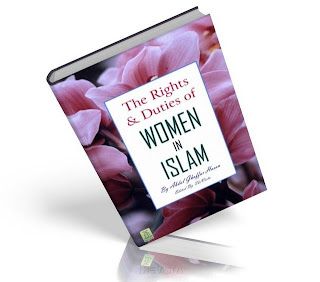
The Rights and Duties of Women in Islam Introduction

The subject of the rights and duties of women in Islam has often been clouded by controversy, personal opinions and sheer ignorance. Although many scholars have dealt with this subject, there has remained a need to discuss wider aspects of the issue than are often tackled. Maulana Abdul Ghaffar Hasan, a scholar of Hadith and member of the Islamic Ideological Council in Pakistan, originally presented this topic to the Council as a short Urdu paper for discussion. Considering it to be a concise yet useful contribution to the field, I rendered it into English. I am very grateful to my daughter Khola Hasan who not only edited the English version but also contributed to it with her thoughts, thus adding to its substance beautifully. 
The Rights and Duties of Women in Islam Introduction book


I hope that this booklet will help to remove some of the misunderstandings, prejudiced opinions and falsehoods, which circulate about the rights, and duties of women in Islam. 


The issue of Women in Islam has been the subject of all kinds of controversies, misunderstandings and especially misinformation. This work will discuss and explain this subject according to the precise teachings of the Qur�aan and the Sunnah (sayings, acts, i.e., the traditions) of Allah�s Messenger. 


To begin with, the most important aspect of the entire issue is the spiritual aspect. The Muslim accepts that the main purpose behind the creation of jinn and mankind was that they should worship Allah, struggle against the forces of Satan and live their life according to Allah's Commandments in order to achieve eternal bliss in Paradise.


Abdul Ghaffar Hasan | Language: English | Format: PDF | Pages: 29 | Size: 5 MB


 Download,   preview


Dr. Suhaib Hasan
التعليقات | | Read More...

Sisterhood in Islam (A Letter from One Muslim SIster to Another)


As Muslims sisters strive to gain knowledge about their religion and endeavor to increase their Iman, there is one issue of importance that often seems to be neglected. This is the issue of Sisterhood in Islam.

Sisters may greet each other, spend time socializing, give gifts during happy occasions, cook for those who have a new baby, etc., but this is only the surface level of Sisterhood. To understand what this special relationship really means we must go much deeper than that.

We need to go to the level of the heart from which the bonds of Sisterhood emanate. This relationship is very special because it involves a unique type of love; one that cannot be experienced in any other social connection. It is a feeling that is particularly extraordinary for those of us who are revert/converts to Islam.

To really enjoy the beauty of this bond we need to completely comprehend the elements that are involved. A letter has been written to each of us to assist us in this endeavor, Insha-Allah. Let us put this knowledge in our hearts and we will begin to see the seeds of true Sisterhood grow into a beautiful, flowering plant, Insha-Allah.

Assalamu Alaikum Wa Rahmatullah Wa Baraktuh

My Dear Sister in Islam:
As Muslims sisters strive to gain knowledge about their religion and endeavor to increase their Iman, there is one issue of importance that often seems to be neglected. This is the issue of Sisterhood in Islam.  Sisters may greet each other, spend time socializing, give gifts during happy occasions, cook for those who have a new baby, etc., but this is only the surface level of Sisterhood. To understand what this special relationship really means we must go much deeper than that.  We need to go to the level of the heart from which the bonds of Sisterhood emanate. This relationship is very special because it involves a unique type of love; one that cannot be experienced in any other social connection. It is a feeling that is particularly extraordinary for those of us who are revert/converts to Islam.  To really enjoy the beauty of this bond we need to completely comprehend the elements that are involved. A letter has been written to each of us to assist us in this endeavor, Insha-Allah. Let us put this knowledge in our hearts and we will begin to see the seeds of true Sisterhood grow into a beautiful, flowering plant, Insha-Allah.

Insha-Allah, everything is well with you and those close to you. I am writing this letter to let you know how much I care and to help us both gain an understanding of what Sisterhood in Islam really means, Insha-Allah. I care about you because we share something that is more special than the whold world and all that it contains; we share the belief in the Onenesss of Allah (SWT) and the religion that He (SWT) has given to us. This is a gift that transcends any differences we may have in regard to race, color, nationality, culture or language. Being a sister in Islam is one of the many blessings that comes from acceptance of the true path of Allah (SWT). It is also a responsibility that we each have as members of the Muslim Ummah. To fufill our obligation, we first need to understand what is required of us.

This is what the bond of Sisterhood in Islam means to me, based upon the wisdom of Allah and his Prophet Muhammad (SAW),
"...And lower your wing for the believers (be courteous to the fellow-believers)." (Al-Hijr 15:88)

The Prophet (SAW) said,

"None of you has Iman (faith) until he desires for his brother (or sister) Muslim that which he desires for himself (or herself)." (Bukhari and Muslim)

He (SAW) also said,

"The Muslims in their mutual love, kindness and compassion are like the human body where when one of its parts is in agony the entire body feels the pain, both in sleeplessness and fever." (Bukhari and Muslim)

I love you for the sake of Allah (SWT) ...
The Messenger of Allah (SAW) said,

"On the Day of Judgement, Allah, the Most High, will announce, 'Where are those who love each other for the sake of My pleasure? This day I am going to shelter them in the shade provided by Me. Today there is no shade except My shade." (Muslim)

I will be sure to tell you of my love, Insha-Allah ...

The Prophet (SAW) said,

"If a person loves his brother, he should inform him of this fact." (Abu Dawud and Tirmidi)

I will be merciful and compassionate toward you, Insha-Allah ...

Allah (SWT) says,

"Muhammad is the Messenger of Allah, and those who are with him are severe against the disbelievers, and merciful among themselves..." (Al-Fath 48:29)

The Prophet (SAW) said,

"Do not be envious of other Muslims; do not overbid at auctions against another Muslim; do not have malice against a Muslim; do not go against a Muslim and forsake him; do not make an offering during a pending transaction. O' servants of Allah, be like brothers (or sisters) with each other. A Muslim is the brother (or sister) of another Muslim; do not hurt him (or her), or look down upon him (or her) or bring shame on him (or her). Piety is a matter of heart (The Prophet (SAW) repeated this thrice). It is enough evil for a person to look down upon his Muslim brother (or sister). The blood, property and honor of a Muslim is inviolable to a Musilm." (Muslim)

I will keep company with you, Insha-Allah ...

The Prophet (SAW) said,

"Keep company with a believer only, and let your food be eaten only by the righteous." (Abu Dawud and Tirmidi)

He (SAW) also said,

"A person is likely to follow the faith of his friend, so look whom you befriend." (Abu Dawud and Tirmidi)

I will help you when necessary and I will cover your shortcomings, Insha-Allah ...

The Prophet (SAW) said,

"One who helps a fellow Muslim in removing his (or her) difficulty in this world, Allah will remove the former's distress on the Day of Judgement. He who helps to remove the hardship of another, will have his difficulties removed by Allah in this world and in the Hereafter. One who covers the shortcomings of another Muslim, will have his faults covered up in this world and the next by Allah. Allah continues to help a servant so long as he goes on helping his own brother (or sister)." (Muslim)

I will encourage you to the right, Insha-Allah ...

Allah (SWT) says,

"The believers, men and women. are Auliya (helpers, supporters, friends, protectors) of one another, they enjoin (on people) Al-Ma'ruf (i.e. Islamio Monotheism and all that Islma orders one to do), and forbids (people) from Al-Munkar (i.e. polytheism and disbelief of all kinds, and all that Islam has forbidden); they offer their prayers perfectly (Iqamat-as-Salat); and give the Zakat and obey Allah and His Messenger. Allah will have His mercy upon them. Surely, Allah is All-Mighty, All-Wise." (At-Tauba 9:71)

When the Prophet (SAW) instructed,

"Help your (Muslim) brother (or sister) when he commits a wrong and when a wrong is committed against him, someone asked, "O Messenger of Allah, I understand how I can help him if a wrong is committed against him, but how can I help him if he is himself committing a wrong?" At that the Prophet (SAW) answered, "Stopping him from committing the wrong is helping him." (Bukhari)

I will fulfill my minimum duties and beyond, Insha-Allah ...

The Prophet (SAW) said,

"A Muslim owes six obligations towards another Muslim: when you meet him (or her), salute him (or her) saying 'Assalamu Alaikum; when he (or she) invites you, accept his (or her) invitation; when he (or she) solicits your advice, advise him (or her) sincerely; when he (or she) sneezes and praises Allah, respond with the supplication Yarhamuk Allah (Allah have mercy on you); when he (or she) falls sick, visit him (or her); on his (or her) death, join his (or her funeral)." (Muslim)

He (SAW) also said,

"When a Muslim visits his (or her) Muslim brother (or sister) who is sick, he (or she) certainly gathers the fruits of Paradise until he (or she) returns (from visiting)." (Muslim)

You should understand, dear sister, that these are only some of the promises that I have made to you and to Allah (SWT), Insha-Allah. I will strive to fufill each of them to the best of my ability, Insha-Allah. Insha-Allah you will do the same for all of your sisters in Islam. This will not only enhance our bounds of Sisterhood, but will also strengthen the fibers of the Muslim Ummah as we acquire and utilize the wisdom of Islam, Insha-Allah. Our ultimate goal is to gain the pleasure of Allah (SWT), as well as His Mercy and Blessings, Insha-Allah. May we both find the true peace that comes with being a Muslim and attaing the highest of rewards: Paradise. Ameen!!!

With true love,

Your Sister in Islam

Walaikum Assalam Wa Rahmatullah Wa Baraktuh

التعليقات | | Read More...

Why Are Women Turning to Islam


At a time when Islam is faced with hostile media coverage particularly where the status of women in
Islam is concerned, it may be quite surprising to learn that Islam is the fastest growing religion in the world, and even more ironic to discover that the majority of converts to Islam are WOMEN

The status of women is society is neither a new issue nor is it a fully settled one, and where Islam is mentioned, for many the term 'Muslim Women' prompts images of exhausted mothers chained to the stove, 'victims' suppressed in a life of indoctrination, frantic to be westernised and so on. Others will go to great lengths to explain how the hijab is an obstacle, clouding the mind, and comment that female converts are either brainwashed, stupid or traitors to their sex. I reject such accusations and pose to them the following question: why is it that so many women who have been born and brought in the so called 'civilized' societies of Europe and America are willing to reject their 'liberty' and 'independence' to embrace a religion that supposedly oppresses them and is widely assumed to be prejudicial to them?

As a Christian convert to Islam, I can only present my personal experience and reasons for rejecting the 'freedom' that women claim to have in this society in favour of the only Religion that truly liberates women by giving us a status and position which is completely unique when compared with that of non-Muslim counterparts.

Before coming to Islam, I had strong feminist tendencies and recognized that where the women was concerned, a lot of shuffling around had been going on, yet without being able to pin her on the social map. The problem was ongoing: new 'women's issues' being raised without the previous ones being satisfactorily resolved. Like the many women who shared my background, I would accuse Islam of being a sexist religion, discriminating, oppressing and giving men the greater privileges. All this coming from a person who did not even know Islam, one who had been blinded due to ignorance and had accepted this deliberately distorted definition of Islam.

However, despite my criticisms of Islam, inwardly I wasn't satisfied with my own status as a women in this society. It seemed to me that society would define such terms as 'liberty' and 'freedom' and then these definitions were accepted by women without us even attempting to question or challenge them. There was clearly a great contradiction between what women were told in theory and what actually happens in practice.

The more I pondered the greater emptiness I felt within. I was slowly beginning to reach a stage where my dissatisfaction with my status as a woman in this society, was really a reflection of my greater dissatisfaction with society itself. Everything seemed to be degenerating backwards, despite the claims that the 1990's was going to be the decade of success and prosperity. Something vital seemed to be missing from my life and nothing would fill this vacuum. Being a Christian did not do anything for me, and I began to question the validity of only remembering God one day a week - Sundays! As with many other Christians too, I had become disillusioned with the hypocrisy of the Church and was becoming increasingly unhappy with the concept of Trinity and the deification of Jesus. Eventually, I began to look into Islam. At first, I was only interested in looking at those issues which specifically dealt with women. I was surprised. What I read and learned taught me a lot about myself as a woman, and also about where the real oppression of women lies: in every other system and way of life outside of Islam. Muslim women have been given their rights in every aspect of the religion with clear definitions of their role in society - as had men - with no injustice against either of them. As Allah says:

Whoever does deeds of righteousness, be they male or female, and have faith, they will enter paradise and not the least injustice will be done to them

[Qur'an Nisa 4:124]

So having amended my misconceptions about the true status of women in Islam, I was now looking further. I wanted to find that thing which was going to fill the vacuum in my life. My attention was drawn towards the beliefs and practices of Islam. It was only through establishing the fundamentals that I would understand where to turn and what to prioritise. These are often the areas which receive little attention or controversy in society, and when studying the Islamic Creed, it becomes clear why this is the case: such concise, faultless and wholly comprehensive details cannot be found elsewhere.
التعليقات | | Read More...

Why Do You Dress Like That


Narrated by: Najiyah Umm Waheeb
 As a Muslim woman I am occasionally asked about my manner of dress. I always try to give a friendly and informative answer, but often either I or the questioners are in a hurry, and they walk away as confused as ever. So allow me to share with you a bit about the Muslim woman's dress in this written form.


As a Muslim woman I am occasionally asked about my manner of dress. I always try to give a friendly and informative answer, but often either I or the questioners are in a hurry, and they walk away as confused as ever. So allow me to share with you a bit about the Muslim woman's dress in this written form.

History

Women's covering like this did not begin with Muslims. Both the Torah and the New Testament instruct women to cover their heads. Consider images of Mary the mother of Jesus. She is always dressed exactly like Muslim women dress today! Practicing Jewish women still cover their heads, although they now do it with wigs instead of scarves, and some Christian sects like the Mennonites and Amish have also retained the head covering. In God's last revelation to mankind, the Qur'an, He also instructs women to cover their beauty.

"Say to the believing women that they should lower their gaze and guard their modesty; that they should not display their beauty and ornaments except what (must ordinarily) appear thereof, that they should draw their veils over their bosoms and not display their beauty except to their husbands, their fathers, their husbands' fathers..." (Qur'an An-Nur, 30-31)

What it Signifies:

Many Westerners associate this type of modesty with submission and the subjugation of women. The reason for this is two-fold. Firstly, they sometimes witness in the media truly oppressed Muslim women, who, ignorant of their own faith are treated poorly in the name of Islam by unscrupulous or equally uneducated men. Secondly, their own history and scriptures predispose them to this belief. Commonly called the "Eve complex" there is a school of thought in Christianity which blames Eve for Adam's sin of eating from the forbidden fruit. The Church's historical view of women as temptresses and soulless vessels of sexual evil is a result of this belief. Additionally Paul associates modesty on the part of women with submission to their husbands when he says in I Corinthians 11:3 "...the head of every women is the man....." But in Islam, although the husband is considered the leader of the family (as every organization has a leader), the two concepts of modesty and obedience are not linked as they were by Paul.

God says in the Qur'an that the believing women should "cast their garments over their persons (when abroad); that is most convenient, that they should be known (as such) and not molested. And Allah is Oft-Forgiving, Most Merciful." [Qur'an Al-Ahzab,59]

So Muslim woman's manner of dress is not a symbol of her submission to man, but rather a symbol of her belief in God. It was prescribed by God to protect women from co modification, objectification and sexualization, which occur when they display themselves to all, and sundry rather than reserving their beauty as something private and precious.

Benefits:

The benefits of covering are many. A Muslim woman forces people to deal with her on a person-to-person level. She is known for her talents, intellect and personality only, not as "fat", "beautiful" or "a red-head". She maintains dignity at a time when women are constantly being treated in a sexually degrading manner- she is not sexually harassed or date raped. A Muslim woman retains the respect and reverence that Western women gave up when they began to mistakenly associate lack of modesty with equality and freedom. Muslim women also retain a healthy body image- young Muslim ladies don't suffer from anorexia or bulimia, spend countless hours on manipulative "beauty magazines" or countless dollars feeding a piranha-like beauty industry in an effort to gain the acceptance of a society that values youth and sex and unattainable perfection. Muslim women are comfortable with themselves, confident and dignified in their covering.

Equality:

In the West the Women' Lib movement was greatly needed. But in reality such a movement was not necessary, because God granted women all the rights they fought for and even more, 1400 years ago. Islam guarantees women the right to be educated, to choose their own spouses, to initiate divorce, to work outside the home, to own property, to own a business and to keep any money earned for themselves if they so choose. Under Islamic law, women have always voted, held public office, participated in society, and spoken out if they disagree with leaders. Muslim women are also the only women anywhere guaranteed inheritance.

The Face Veil:

At the time of the Prophet Mohammed (peace and blessings of Allah be upon him), the "outer garments" with which the women covered themselves were sheet-like cloaks which covered everything, leaving only the eyes showing if necessary. There is a difference of opinion among Muslim scholars as to whether the face must then, by definition, be covered. I personally believe that in all matters the correct interpretation is that of the companions of the Prophet himself (peace be upon him) and the earliest scholars. By far most of them taught that the face must be covered. In my research of the Qur'an I also cannot see another interpretation! I am part of a growing movement of "modern", educated Muslim women who are striving to return to this spiritually uplifting practice. God willing it will then lose its reputation as being oppressive and will come to stand for faith, dignity and respect, as it originally did.
التعليقات | | Read More...

The Status of Woman in Islam


By Hammuda Abdul-Ati, PH.D. from "Islam in focus"
 The status of woman in Islam constitutes no problem. The attitude of the Qur'an and the early Muslims bear witness to the fact that woman is, at least, as vital to life as man himself, and that she is not inferior to him nor is she one of the

The status of woman in Islam constitutes no problem. The attitude of the Qur'an and the early Muslims bear witness to the fact that woman is, at least, as vital to life as man himself, and that she is not inferior to him nor is she one of the lower species. Had it not been for the impact of foreign cultures and alien influences, this question would have never arisen among the Muslims. The status of woman was taken for granted to be equal to that of man. It was a matter of course, a matter of fact, and no one, then, considered it as a problem at all.

In order to understand what Islam has established for woman, there is no need to deplore her plight in the pre-Islamic era or in the modern would of today. Islam has given woman rights and privileges, which she has never enjoyed under other religious or constitutional systems. This can be understood when the matter is studied as a whole in a comparative manner, rather than partially. The rights and responsibilities of a woman are equal to those of a man but they are not necessarily identical with them. Equality and sameness are two quite different things. This difference is understandable because man and woman are not identical but they are created equals. With this distinction in mind, There is no problem. It is almost impossible to find even two identical men or women.

This distinction between equality and sameness is of paramount importance. Equality is desirable, just, fair; but sameness is not. People are not created identical but they are created equals. With this distinction in mind, there is no room to imagine that woman is inferior to man. There is no ground to assume that she is less important than he just because her rights are not identically the same as his. Had her status been identical with his, she would have been simply a duplicate of him, which she is not. The fact that Islam gives her equal rights - but not identical - shows that it takes her into due consideration, acknowledges her, and recognizes her independent personality.

It is not the tone of Islam that brands woman as the product of the devil or the seed of evil. Nor does the Qur'an place man as the dominant lord of woman who has no choice but to surrender to his dominance. Nor was it Islam that introduced the question of whether or not woman has any soul in her. Never in the history of Islam has any Muslim doubted the human status of woman or her possession of soul and other fine spiritual qualities. Unlike other popular beliefs, Islam does not blame Eve alone for the First Sin. The Qur'an makes it very clear that both Adam and Eve were tempted; that they both sinned; that God's pardon was granted to both after their repentance; and that God addressed them jointly. (2:35-36); 7:19, 27; 20:117-123). In fact the Qur'an gives the impression that Adam was more to blame for that First Sin from which emerged prejudice against woman and suspicion of her deeds. But Islam does not justify such prejudice or suspicion because both Adam and Eve were equally in error, and if we are to blame Eve we should blame Adam as much or even more.

The status of woman in Islam is something unique, something novel, something that has no similarity in any other system. If we look to the Eastern Communist world or to the democratic nations, we find that woman is not really in a happy position. Her status is not enviable. She has to work so hard to live, and sometimes she may be doing the same job that a man does but her wage is less than his. She enjoys a kind of liberty which in some cases amounts to libertinism. To get to where she is nowadays, woman struggled hard for decades and centuries. To gain the right of learning and the freedom of work and earning, she had to offer painful sacrifices and give up many of her natural rights. To establish her status as a human being possessing a soul, she paid heavily. Yet in spite of all these costly sacrifices and painful struggles, she has not acquired what Islam has established by a Divine decree for the Muslim woman.

The rights of woman of modern times were not granted voluntarily or out of kindness to the female. Modern woman reached her present position by force, and not through natural processes or mutual consent or Divine teachings. She had to force her way, and various circumstances came to her aid. Shortage of manpower during wars, pressure of economic needs and requirements of industrial developments forced woman to get out of her home - to work, to learn, to struggle for her livelihood, to appear as an equal to man, to run her race in the course of life side by side with him. She was forced by circumstances and in turn she forced herself through and acquired her new status. Whether all women were pleased with these circumstances being on their side, and whether they are happy and satisfied with the results of this course is a different matter. But the fact remains that whatever rights modern woman enjoys fall short of those of her Muslim counterpart.

What Islam has established for woman is that, which suits her nature, gives her full security and protects her against disgraceful circumstances and uncertain channels of life. We do not need here to elaborate on the status of modern woman and the risks she runs to make her living or establish herself. We do not even need to explore the miseries and setbacks that encircle her as a result of the so-called rights of woman. Nor do we intend to manipulate the situation of many unhappy homes which break because of the very "freedom" and "rights" of which modern woman is proud.

Most women today exercise the right of freedom to go out independently, to work and earn, to pretend to be equal to man, but this, sadly enough, is at the expense of their families. This all known and obvious. What is not known is the status of woman in Islam. An attempt will be made in the following passages to sum up the attitude of Islam with regard to woman.

1. Woman is recognized by Islam as a full and equal partner of man in the procreation of humankind. He is the father; she is the mother, and both are essential for life. Her role is not less vital than his. By this partnership she has an equal share in every aspect; she is entitled to equal rights; she undertakes equal responsibilities, and in her there are as many qualities and as much humanity as there are in her partner. To this equal partner- ship in the reproduction of human kind God says:

O mankind! Verily We have created your from a single (pair) of a male and a female and made you into nations and tribes that you may know each other...

Qur'an, 49:13; 4:1

2. She is equal to man in bearing personal and common responsibilities and in receiving rewards for her deeds. She is acknowledged as an independent personality, in possession of human qualities and worthy of spiritual aspirations. Her human nature is neither inferior to nor deviant from that of man. Both are members of one another. God says:

And their Lord has accepted (their prayers) and answered them (saying): 'Never will I cause to be lost the work of any of you, be he male or female; you are members, one of another...

Qur’an 3:195; 9:71;33:35-36;66:19-2

3. She is equal to man in the pursuit of education and knowledge. When Islam enjoins the seeking of knowledge upon Muslims, it makes no distinction between man and woman. Almost fourteen centuries ago, Muhammad declared that the pursuit of knowledge is incumbent on every Muslim male and female. This declaration was very clear and was implemented by Muslims throughout history.

4. She is entitled to freedom of expression as much as man is. Her sound opinions are taken into consideration and cannot be disregarded just because she happen to belong to the female sex. It is reported in the Qur'an and history that woman not only expressed her opinion freely but also argued and participated in serious discussions with the Prophet himself as well as with other Muslim leaders (Qur'an, 58:1-4; 60:10-12). Besides there were occasions when Muslim women expressed their views on legislative matters of public interest, and stood in opposition to the Caliphs, who then accepted the sound arguments of these women. A specific example took place during the Caliphate of Umar Ibn al-Khattab.

5. Historical records show that women participated in public life with the early Muslims, especially in times of emergencies. Women used to accompany the Muslim armies engaged in battles to nurse the wounded, prepare supplies, serve the warriors, and so on. They were not shut behind iron bars or considered worthless creatures and deprived of souls.

6. Islam grants woman equal rights to contract, to enterprise, to earn and possess independently. Her life, her property, her honour are as sacred as those of man. If she commits any offence, her penalty is no less or more than of man's in a similar case. If she is wronged or harmed, she gets due compensations equal to what a man in her position would get (2:178;4:45, 92-93).

7. Islam does not state these rights in a statistical form and then relax. It has taken all measures to safeguard them and put them into practice as integral articles of Faith. It never tolerates those who are inclined to prejudice against woman or discrimination between man and woman. Time and again, the Qur'an reproaches those who used to believe woman to be inferior to man (16:57-59, 62; 42:47-59; 43:15-19; 53:21-23).

8. Apart from recognition of woman as an independent human being acknowledged as equally essential for the survival of humanity, Islam has given her a share of inheritance. Before Islam, she was not only deprived of that share but was herself considered as property to be inherited by man. Out of that transferable property Islam made an heir, acknowledging the inherent human qualifies in woman. Whether she is a wife or mother, a sister or daughter, she receives a certain share of the deceased kin's property, a share which depends on her degree of relationship to the deceased and the number of heirs. This share is hers, and no one can take it away or disinherit her. Even if the deceased wishes to deprive her by making a will to other relations or in favour of any other cause, the Law will not allow him to do so. Any proprietor is permitted to make his will within the limit of one-third of his property, so he may not affect the rights of his heirs, men and women. In the case of inheritance, the question of quality and sameness is fully applicable. In principle, both man and woman are equally entitled to inherit the property of the deceased relations but the portions they get may vary. In some instances man receives two shares whereas woman gets one only. This no sign of giving preference or supremacy to man over woman. The reasons why man gets more in these particular instances may be classified as follows:

First man, is the person solely responsible for the complete maintenance of his wife, his family and any other needy relations. It is his duty by Law to assume all financial responsibilities and maintain his dependents adequately. It is also his duty to contribute financially to all good causes in his society. All financial burdens are borne by him alone.

Secondly, in contrast, woman has no financial responsibilities whatsoever except very little of her personal expenses, the high luxurious things that she likes to have. She is financially secure and provided for. If she is a wife, her husband is the provider; if she is a mother, it is the son; if she is a daughter, it is the father; if she is a sister; it is the brother, and so on. If she has no relations on whom she can depend, then there is no question of inheritance because there is nothing to inherit and there is no one to bequeath anything to her. However, she will not be left to starve, maintenance of such a woman is the responsibility of the society as a whole, the state. She may be given aid or a job to earn her living, and whatever money she makes will be hers. She is not responsible for the maintenance of anybody else besides herself. If there is a man in her position, he would still be responsible for his family and possibly any of his relations who need his help. So, in the hardest situation her financial responsibility is limited, while his is unlimited.

Thirdly, when a woman gets less than a man does, she is not actually deprived of anything that she has worked for. The property inherited is not the result of her earning or her endeavours. It is something coming to them from a neutral source, something additional or extra. It is something that neither man or woman struggled for. It is a sort of aid, and any aid has to be distributed according to the urgent needs and responsibilities especially when the distribution is regulated by the Law of God.

Now, we have a male heir, on one side, burdened with all kinds of financial responsibilities and liabilities. We have, on the other side, a female heir with no financial responsibilities at all or at most with very little of it. In between we have some property and aid to redistribute by way of inheritance. If we deprive the female completely, it would be unjust to her because she is related to the deceased. Likewise, if we always give her a share equal to the man's, it would be unjust to him. So, instead of doing injustice to either side, Islam gives the man a larger portion of the inherited property to help him to meet his family needs and social responsibilities. At the same time, Islam has not forgotten her altogether, but has given her a portion to satisfy her very personal needs. In fact, Islam in this respect is being more kind to her than to him. Here we can say that when taken as a whole the rights of woman are equal to those of man although not necessarily identical (see Qur'an, 4:11-14, 176).

9. In some instances of bearing witness to certain civil con- tracts, two men are required or one man and two women. Again, this is no indication of the woman being inferior to man. It is a measure of securing the rights of the contracting parties, because woman as a rule, is not so experienced in practical life as man. This lack of experience may cause a loss to any party in a given contract. So the Law requires that at least two women should bear witness with one man. if a woman of the witness forgets something, the other one would remind her. Or if she makes an error, due to lack of experience, the other would help to correct her. This is a precautionary measure to guarantee honest transactions and proper dealings between people. In fact, it gives woman a role to play in civil life and helps to establish justice. At any rate, lack of experience in civil life does not necessarily mean that women are inferior to man in her status. Every human being lacks one thing or another, yet no one questions their human status (2:282).

10. Woman enjoys certain privileges of which man is deprived. She is exempt from some religious duties, i.e., prayers and fasting, in her regular periods and at times of confinement. She is exempt from all financial liabilities. As a mother, she enjoys more recognition and higher honour in the sight of God (31:14-15;46:15). The Prophet acknowledged this honour when he declared that Paradise is under the feet of the mothers. She is entitled to three-fourths of the son's love and kindness with one-fourth left for their father. As a wife she is entitled to demand of her prospective husband a suitable dowry that will be her own. She is entitled to complete provision and total maintenance by the husband. She does not have to work or share with her husband the family expenses. She is free to retain, after marriage, whatever she possessed before it, and the husband has no right whatsoever to any of her belongings. As a daughter or sister she is entitled to security and provision by the father and brother respectively. That is her privilege. If she wishes to work or be self-supporting and participate in handling the family responsibilities, she is quite free to do so, provided her integrity and honour are safeguarded.

11. The standing of woman in prayers behind man does not indicate in any sense that she is inferior to him. Woman, as already mentioned, is exempt from attending congregational prayers, which are obligatory on man. But if she does attend she stands in separate lines made up of women exclusively . This is a regulation of discipline in prayers, and not a classification of importance. In men's rows the head of state stands shoulder to shoulder to the pauper. Men of the highest ranks in society stand in prayer side by side with other men of the lowest ranks. The order of lines in prayers is introduced to help every one to concentrate in his meditation. It is very important because Muslim prayers are not simply chanting or the sing-a-song type. They involve actions, motions, standing, bowing, prostration, etc. So if men mix with women in the same lines, it is possible that something disturbing or distracting may happen. The mind will become occupied by something alien to prayer and derailed from the clear path of mediation. The result will be a loss of the purpose of prayers, besides an offence of adultery committed by the eye, because the eye-by looking at forbidden things - can be guilty of adultery as much as the heart itself. Moreover, no Muslim man or woman is allowed during prayers to touch the body of another person of the opposite sex. If men and women stand side by side in prayer they cannot avoid touching each other. Furthermore, when a woman is praying in front of a man or beside him, it is very likely that any part of her dressed body may become uncovered after a certain motion of bowing or prostrating. The man's eye may happen to be looking at the uncovered part, with the result that she will be embarrassed and he will be exposed to distraction or possibly evil thoughts. So, to avoid any embarrassment and distraction to help concentrate on mediation and pure thoughts, to maintain harmony and order among worshippers, to fulfil the true purposes of prayers, Islam has ordained the organization of rows, whereby men stand in front lines, and women behind the children. Anyone with some knowledge of the nature and purpose of Muslim prayers can readily understand the wisdom of organizing the lines of worshippers in this manner.

12. The Muslim woman is always associated with an old tradition known as the "veil". It is Islamic that the woman should beautify herself with the veil of honour, dignity, chastity, purity and integrity. She should refrain from all deeds and gestures that might stir the passions of people other than her legitimate husband or cause evil suspicion of her morality. She is warned not to display her charms or expose her physical attractions before strangers. The veil which she must put on is one that can save her soul from weakness, her mind from indulgence, her eyes from lustful looks, and her personality from demoralization. Islam is most concerned with the integrity of woman, with the safeguarding of her morals and morale and with the protection of her character and personality (Qur'an, 24:30-31).

13. By now it is clear that the status of woman in Islam is extremely high (in comparison to other religions) and realistically suitable to her nature. Her rights and duties are equal to those of man but not necessarily or absolutely identical with them. If she is deprived of one thing in some aspect, she is fully compensated for it with more things in many other aspects. The fact that she belongs to the female sex has no bearing on her human status or independent personality, and it is no basis for justification of prejudice against her or injustice to her person. Islam gives her as much as is required of her. Her rights match beautifully with her duties. The balance between rights and duties is maintained, and no side overweighs the other. The whole status of woman is given clearly in the Qur'anic verse which may be translated as follows:

And women shall have rights similar to the rights against them, according to what is equitable; but man have a degree (of advantage as in some cases of inheritance) over them

(Qur’an 2:228)

This degree is not a title of supremacy or an authorization of dominance over her. It is to correspond with the extra responsibilities of man and give him some compensation for his unlimited liabilities. The above mentioned verse is always interpreted in the light of another (4:34).

It is these extra responsibilities that give man a degree over woman in some economic aspects. It is not a higher degree in humanity or in character. Nor is it a dominance of one over the other or suppression of one by the other. It is a distribution of God's abundance according to the needs of the nature of which God is the Maker. And He knows best what is good for woman and what is good for man. God is absolutely true when He declares:

        O mankind! reverence your Guardian-Lord, Who created you from a single  person, and created of like nature his mate, and from them twain scattered (like seeds) countless men and women. (Qur’an 4:1)


التعليقات | | Read More...

Search in Wikipedia

Search results

FOLLOW US ON TWITTER

Followers

Search in islamic language

Contact Form

Name

Email *

Message *

About

Add to Google Reader or Homepage

Invite friends on Facebook


Invite your friends

Blogger news

Total Pageviews

Suscribirse ahora standard

Entri Populer

 
Company Info | Contact Us | Privacy policy | Site map
You can benefit and spread the content of our website in any means without changing it and with referring to the source. Copyright © 2013 islamic language
Modify and develop islamic Language | Powered by Blogger
Found on Google+